The size of things: biz hundert un tsvantsik

When I first started on the book A Certain Gesture: Evnine’s Batman Meme Project and Its Parerga!, I thought to include all the memes (53) that I had posted on Facebook as part of the Batman Meme Project between January and March 2016 (including three that appeared only in the movie Evnine’s Batman Memes: The Movie that was the climactic finale of the Batman Meme Project). Among the parerga were to be six memes I had created at the same time but elected not to post on Facebook (there were others I excluded), and 61 memes I made subsequent to the Batman Meme Project. That made for a total of 120 in all.

I liked that the total was 120 (and determined on it even before finishing all the included post-project memes) for two reasons. First, it is the age by reference to which Jews wish on others a long life (biz hundert un tsvantsik, in Yiddish), in honor of Moses, who was 120 when he died looking over into the promised land he would never enter. Secondly, and perhaps more importantly, it is the number of the apartment in London in which I was born and in which I lived until, at 18, my parents did cross over into that promised land unattained by Moses, leaving me alone in London, effectively (like both Batman and Robin) an orphan. In a sense, you could say that my delivery was prolonged by 18 years, the apartment being a prosthetic uterus. (I often reflect on the fact that for various periods, my bedroom in that apartment was the very room in which I had been born.) It wasn’t until I was forced to leave no. 120 that I finally, fully, tumbled from fetal grace. That event must have been (I say “must have been” rather than “was” because I struggle to remember my feelings) experienced by me as, well… a slap in the face! (Not that my childhood before then was especially happy. But I was sheltered.)

Screen Shot 2018-08-03 at 2.42.06 PM

In any case, over time, I came to feel that some of the 120 memes were too weak to be included. I also created a few more which I was sorry would not find a place in the book. Finally, after much agonizing, and with the urging of the other University of Miami Center for the Humanities fellows last academic year, I decided to monkey about with the original selection, omitting and adding with the goal of getting the best memes and not trying to conform to this magical number, however personally significant it was for me. There are now going to be roughly 105 memes altogether. I think this is for the best, but I have to say that all of a sudden, the project feels somehow diminished to me. Not just because it has fewer memes in it. Rather, the work as a whole now seems to me less ambitious, less daring. Instead of the envisaged polyphonic texture, in which themes appear and re-appear, cutting across the division into discrete commentaries and the division between memes and commentaries, I now see a series of short essays interspersed with quite a few perfunctory commentaries in which I will have very little to say. Right now, the projected book strikes me as somewhat pitiful.

I am (fairly) sure this is just a phase and that I will eventually recapture something of the original, animating vision. All lengthy projects involve such phases, surely. The phases are the results of interferences between multiple currents. One current flows from the ‘oceanic feeling’ when the work is not fully formed and contains so much in potential to its birth as a diminished actuality. Another comes in bursts as new ideas unpredictably present themselves, new connections appear. A third involves the relinquishing of anxiety over whether one can actually do what one set oneself to do and a growing amazement at the real little fingers and toes that come into being. And all of these, of course, are superimposed on the currents of the rest of one’s life, with their own vicissitudes. Still, let no-one any longer wish me “biz hundert un tsvantsik.” That number is behind me, not ahead.

Simcha Bunim/simkhe-bunim

When I first created the Yiddish Batman meme, I had to come up with a ‘Jewish’ name for Batman.

Simcha-Bunim-revised

Robin: What is your Jewish name, Batman?
Batman: Call me *Mr* Batman, Boy Wonder.
And my Jewish name is Simcha Bunim.

I don’t now remember the exact thought process that eventuated in “Simcha Bunim,” other than that I wanted something that would sound a bit comic. (Apologies to anyone whose name actually is Simcha Bunim.) I see now, for reasons briefly mooted here, that I may have taken a first, tottering step towards vicious stereotyping at that point. The question of the meme’s relation to stereotyping is something I have now incorporated discussion of in the commentary on the meme. I was greatly helped on my way to this end by my ‘irascible’ expert (introduced here and further mentioned here). Truth be told, he came to the conclusion that my meme, in the light of the commentary (of which he saw an earlier, unreconstructed version), was “repulsive”! (You can see I am still processing the trauma of this.)

But the point of the present post is not to linger on that calamity, but to express my amazement at just how much there has been to say about the name “Simcha Bunim.” I wonder if I just got lucky and picked a name that raised so many interesting issues, or whether any name would have yielded comparable riches.

Specifically,

Continue reading “Simcha Bunim/simkhe-bunim”

… in which I am called out (for humorously linking Batman and Yiddish)

In the on-going saga of my commentary on the Yiddish Batman meme, I mentioned, in my previous post, an ‘irascible’ expert who found the draft of the commentary I sent him to be riddled with errors. af a nar makht men nit kin peyresh, he said. (“One doesn’t write a commentary on a fool.”) It turns out that at that point, he had only skimmed what I had written. Now he has read it fully and things have gone from bad to worse, though the focus has shifted from my scholarly shortcomings to my ethical failures.

At one point in my commentary, recounting a little of the history of Yiddish, I write:

Starting in the second half of the 18th century, Jewish proponents of the Enlightenment began to stigmatize Yiddish as merely a debased form of German that kept its native speakers from accessing European high culture. The image of Yiddish as a comic, backward, folksy language began to take shape, in contrast to dominant European languages, on the one hand, and Hebrew, on the other – an image that even many subsequent supporters of Yiddish have been happy to accept.

In earlier versions of the draft, I then inserted a footnote in which I mentioned a recent exemplar of the “Yiddish supporter accepting the comic view of Yiddish” phenomenon, a book that starts with a joke about a kvetching Jew on a train and then says: “If you can understand this joke, you’ll have no trouble learning Yiddish.” (Because the essence of the language is the ability to kvetch in it, and knowing that smooths the way over all the bothersome conjugations, declensions, etc.) I noted that “such works appear to extoll the virtues of Yiddish, provided one forgets that the works of Cervantes, Swift, Marx, Einstein, Gilbert and Sullivan, Whitman, Dickens, Shakespeare, and Milton (to name just a few) were all translated into it.” At one point, I even mentioned, in studied proximity to this footnote, Sander Gilman’s book Jewish Self-Hatred. However, I removed both footnotes because the implication about the book I objected to was clearly offensive.

Continue reading “… in which I am called out (for humorously linking Batman and Yiddish)”

af a nar makht men nit kin peyresh

In my previous post on this blog I mentioned that I had just finished the commentary on a Batman meme that was in Yiddish. I had sought a lot of help in writing this commentary since, not to put too fine a point on it, I often didn’t know what I was talking about. Among those to whom I turned was a very distinguished but somewhat irascible expert on Yiddish. (Do I give away his identity, to those in the know, if I say that he prefers to call that language “Yidish”?)

I sent him the completed draft of the commentary, 8,000-9,000 words long, and, with amazing generosity, he read it all! In it, I briefly mentioned the role Google Translate played in my quest to obtain the Yiddish text for the meme.  I summarize this expert’s response to my commentary using a Yiddish proverb he himself used in reference to Google Translate’s Yiddish:

No-commentary-on-a-fool

I can only hope, on the basis of his kind offer to help me improve my text, that he does not think me too much of a fool! (But note, for future reference, the small “a” at the beginning of “af a nar.”)

Continue reading “af a nar makht men nit kin peyresh”

A Yiddish Meme

One of the memes in the Batman Meme Project is entirely in Yiddish. I have just finished the nearly six-week process of writing (a draft of) the commentary on it – and it has turned out to be the longest commentary, by far, yet written. (I suspect it will remain the longest, but who knows! I didn’t expect this one to be so long.)

When I was composing the meme, back in Spring 2016, I had help with the Yiddish from a friend of a friend. I had produced the Yiddish text by using Google Translate, but it didn’t look all that right to me and I had no way of knowing if it was idiomatic, or even basically correct. This kind person helped get it into shape and, as part of that, she changed the Romanization (Yiddish is written in Hebrew characters) according to a standard established by YIVO – a Jewish and Yiddish cultural organization founded in 1925. That, she said in an off-hand remark, gave the text a ‘Lithuanian slant.’

Although my commentary touches on many things (the relation of speech and writing, Jewish naming practices, the etymology of one particular Jewish name, Robin Jeshion’s proposed principle of Single Tagging – basically, you shouldn’t name something if you think it already has a name, and others), the thing I got most caught up in was this ‘Lithuanian slant.’

Continue reading “A Yiddish Meme”

Increasingly Verbose: Let’s eat(,) Grandma

Increasingly Verbose is a meme in which a number of panels are placed in a vertical column. Each panel has an image and some text, usually the text adjacent to the image. In the top panel, the image is rich in detail and the text sparse. In succeeding panels, the original image is rendered increasingly abstractly and the original text increasingly verbosely. (Other names for this meme emphasize the progression of the image component – “Deconstructed Memes,” “Meme Decay,” etc..) Here is an example, taken from the webpage linked to above:

9f7

Continue reading “Increasingly Verbose: Let’s eat(,) Grandma”

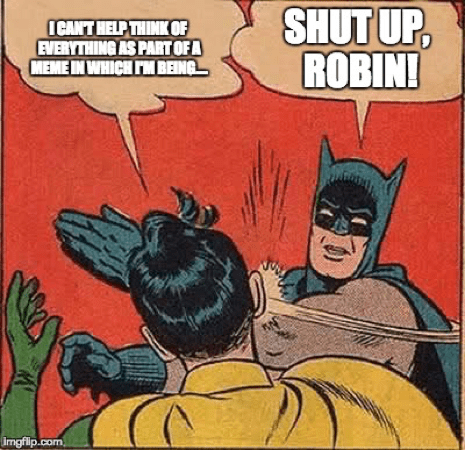
M.1 “… a meme in which I’m being…”

Some time ago, before I started the dedicated Facebook page which turned into this blog, I posted several excerpts from my book-in-progress. Now I have this blog, I thought I would re-post them here. The first one I posted was the first Batman meme I ever made and will be the first in the book, accordingly. I re-reproduce it below, as close as I can to how I envisage it on the printed page. I now think, however, that the treatment of the philosophical issues in the antepenultimate paragraph is inadequate and will need to be rewritten at some point.

M.1 … a meme in which I’m being…

Picture1


M.1: … a meme in which I’m being…  Composed: January 27th. Posted: January 27th. Orientation: Reverse. Font: Impact, with font shadow. TB1: “I can’t help think of everything as part of a meme in which I’m being…”, white, with black borders. TB2: “Shut up, Robin!”, white, with black borders.


The technique of this, as of all the earliest memes (M.1-M.4), is crude. The default settings of the meme generator used by the artist (Impact font, with font shadow, all capitals, white letters with black borders) are left in place, almost certainly because at that stage, he did not realize they could be changed. They are highly unsuitable settings where there is a lot of text (see the technically disastrous M.3). Even here, where there is not that much text, Robin’s words are quite hard to make out.[1] Continue reading “M.1 “… a meme in which I’m being…””

Challenges

One of the things I have most appreciated about working on A Certain Gesture: Evnine’s Batman Meme Project and Its Parerga! is the way it has forced me to be creative when I have had to talk about the work or present it to people in formal or semi-formal settings. Very difficult, and not so rewarding, has been the presentation of the project in applications for sabbaticals, fellowships, and funding (with variable results!). This is, of course, because such presentations are petitions and one cannot stray too far from the traditional forelock tugging in making one’s petitions.

Much more rewarding have been the presentations made to people without goal of profit – in universities and private homes. The peculiar nature of the project, and its unsuitability to exposition in anything like a normal academic format, has flummoxed me right from the start and has thereby forced me to be creative in unexpected ways. Generally, I have had to make my presentations a performance. I suppose all academic presentations involve some element of performance, but in these cases, I really had to go way beyond my comfort zone, in both presentation and content. I have had, in my own limited way, to mug for the audience (something I detest usually), to act a part, and to embarrass myself by personal exposure. (Not of the taking off of one’s clothes variety!)

Continue reading “Challenges”