A problem of notation

Several times, now, I have alluded to a song I made up using the many names I bestowed upon my much-loved cat Celestino (c.1992-c.2002). (He was named after Pope Celestine V, the patron saint of bookbinders. Celestine was followed by Boniface VIII when the latter placed a speaking tube in the wall of Celestine’s room and, impersonating the Holy Ghost, urged him to abdicate.) The issue is relevant to my project for two reasons. First, it forms the basis of an objection to a philosophical thesis, defended by the philosopher Robin Jeshion, that our practice of naming is regulated by an ideal that one should not give a name to something if one knows it already has a name. Secondly, I noted that I have a kind of psychological block about saying nonsense words and the revelation of the text of my song is part of an attempt, through the psychoanalysis that my book is largely about, to overcome this inhibition.

Well, here goes nothing:

I have a little grey cat
I have a little calico cat
And his name is Zemeckis
And his name is Tenbrooks
And his name is Boon Boy
And his name is Farabiano Butel
And his name is Macky Bee
And his name is Farabutles
And his name is Boxim
And his name is Bocca
And his name is Boyottles
And his name is Bunols.

The song is, like Echad Mi Yodea and Green Grow the Rushes, O, a cumulative song. The first iteration consists of the first two lines and the last. The second inserts the penultimate line, and so on, till the last iteration goes through the whole litany.

I will also, in the book, provide the melody but, as you can imagine, this presents a problem of how to notate a cumulative song. Should one just write out the final iteration, as I did with the text, and add an explanation like the one in the previous paragraph? Should one just write the first iteration and then separately provide the melody for the inserted lines? In the end, I decided to write the first and second iterations, setting off the inserted line in the second with repeat marks on either side and a comment above that one should repeat the phrase as many times as one has names to sing.

And-his-name-is-Bunols-score

Take dthat!

Next week, I am going to teach again David Kaplan‘s wonderful paper “Dthat.” David was one of my teachers in graduate school and although I did not work especially closely with him, I had enough experience of him to be smitten. He had, and no doubt still has, a luminous and humorous intelligence that was utterly beguiling, both personally and intellectually.

It’s a bit hard to explain what “dthat” is to those not immersed in analytic philosophy of language but I’ll give it a try. Kaplan, in the paper of that name, is discussing the semantics of the English demonstrative “that” and makes certain conjectures about how it might be used. Rather than argue over the substantive question of whether the English expression is used in the conjectured way, Kaplan employs a technique not uncommon in analytic philosophy (another instance of which I touch on in my post Shmidentity Politics) and introduces a neologism about which he can stipulate the features that are merely conjectured to apply in the real-life case. “Dthat,” (pronounced exactly like “that”) is a demonstrative device about which roughly the following is stipulated: when it appears in a sentence, what it contributes to the meaning of an utterance of the sentence is nothing other than the object demonstrated. This extends to its use when coupled with descriptive content. So in an utterance of “Dthat slap you just gave me really hurt,” the meaning of the expression “[the] slap you just gave me” does not enter into the meaning expressed by the utterance, but functions in something like the way pointing does, if I point to an ice sculpture and say “Dthat is going to melt pretty soon.” The pointing is, we might say, a parergon to the meaning of the utterance; and just so is the meaning of “[the] slap you just gave me” a kind of linguistic parergon – a paratext – to the meaning of the utterance in question.

A long-standing question for philosophers of language is whether proper names function, semantically, in a way similar to “dthat.” Proper names, Kaplan says, are a “theoretician’s nightmare.” He concludes that “if it weren’t for the problem of how to get the kids to come in for dinner, I’d be inclined to just junk them.” Perhaps because his character is so evident in this sentence, it’s always been one my favorite bits of philosophy! Of course, unsurprisingly, there is a very deep point there too. Names are used not only to refer, which is how almost all philosophers of language approach them, but to address as well, to interpellate (as Althusser puts it). It is, Kaplan suggests, their use as means of interpellation that makes it impossible to get by without proper names.

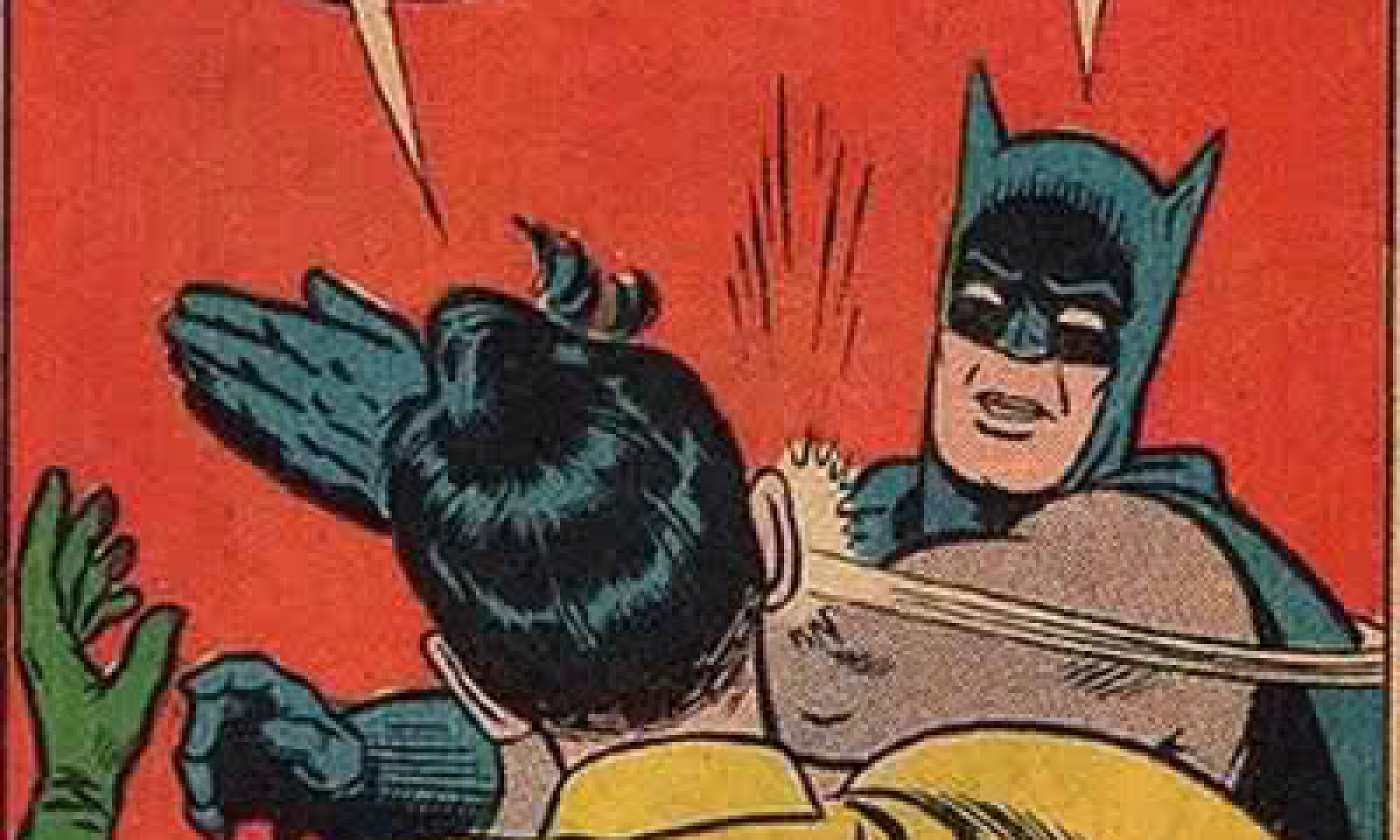
This is the background to a meme, composed several years after most of the others that will appear in my book, that will be the final entry in A Certain Gesture: Evnine’s Batman Meme Project and Its Parerga!. In it, I combine the form of the Batman-slapping-Robin meme with that of another meme: Broke-Woke-Bespoke. This allows for some allegedly tired content (though I hope this post makes evident how inappropriate I think it is to regard Kaplan’s original formulation as in any way tired!) to be transformed into a ‘woke’ version, and ultimately into a ‘bespoke’ version, the acme of its possible expressions.

A Yiddish story “about” Geronimo, Pocahontas, and Sitting Bull

I have posted several times about my Yiddish Batman meme in my book A Certain Gesture: Evnine’s Batman Meme Project and Its Parerga!. One of those posts (“Shmidentity Politics,” about Kripke’s coinage of the term “schmidentity” – the discrepancy in spelling between the name of my post and Kripke’s coinage is significant) includes text that is incorporated into a footnote to a footnote to a footnote to the commentary on that meme. Here, lightly edited to stand alone, is the middle footnote in the chain, the one to which “Shmidentity Politics” is a footnote.

A paper by David L. Gold bears the title “A Story about Pocahontas, Geronimo, and Sitting Bull in Yiddish” (1983)… It involves a father “dzheronevits” (Geronimo), a mother “pokeyente” (Pocahontas), their daughter “mine-horevits” (Minnehaha), along with “siting-bulvan” (Sitting Bull), and “meshugn-ferd” (Crazy Horse). Two indigenous tribes are mentioned: “shvarts-fusike” (Blackfeet) and “shmohoker” (Mohawks). Gold calls these names “Yiddishizations” or “partial Yiddishizations.” (Of course, what they are (partial) Yiddishizations of are probably not the original names in indigenous languages but the Anglicizations (or possibly, depending on the story’s origins, the Russifications, or Polifications, or Germanifications) of those originals. The Yiddishizations work both by translation (“meshugn-ferd” for “Crazy Horse”) and assonance (“dzheronevits” for “Geronimo”), two relations, as we have seen, that often relate a kinuy [secular name] to a shem kodesh [Jewish, or holy, name]. [The relation between Jewish and secular names is a main theme of the meme and the commentary on it.]) Gold says the story is about Pocahontas, Geronimo, and Sitting Bull. But Pocahontas and Geronimo were not married, lived in different centuries, thousands of miles from each other, and did not have Minnehaha (a fictional character) as a daughter! Does the story really say of them that they were and did? Other than being indigenous Americans, there is no resemblance at all between the characters in the story and the people Gold says the story is about.

Robin Jeshion (2002) has emphasized the way in which proper names, as such, can enable thought and talk about their bearers (de re thought and talk, to use the philosophical jargon), regardless of which features those bearers are represented as having or not having. (See the commentary on M.29 (Who Knows Two?) for an account of Jeshion’s views on this matter.) Jeshion draws on Saul Kripke’s seminal work (1980) according to which names are generally bestowed on things in acts of naming and then passed along through historical chains that allow later people to refer to the original bearers of the name despite possibly having no direct access to them. Gold’s claim that the Yiddish story in question is about Pocahontas, etc., is a good case study. For while, we may suppose, there were historical links between the Yiddish names in the story and the original names of the people referred to by Gold in his title, the story itself does not use those bestowed names but rather names that might be considered to be different, though resembling, names. Gold’s claim about the story’s subject matter shows that a view like Jeshion’s really must work hand in hand with an account of the identity of names. When are two variants considered forms of the same name and when of different names? And conversely, reflection on the philosophy of proper names shows that a claim like that in Gold’s title must really be offered only with great caution. It is not at all uncontroversial to say that the story in question is about Pocahontas, Geronimo, and Sitting Bull.

Simcha-Bunim-revised