Excisions: 2

I mentioned in a couple of previous posts that I decided to excise a number of the memes that were going to be part of my book. It was sufficient for a meme to be excluded that I did not envisage being able to write anything of interest (to me) in the commentary on it. I have now set myself the goal of posting the excised memes here, in an occasional series, and trying to write something of interest (to me) about them, thus proving my decision to exclude them mistaken! Also, in this parergonal space around the book, I will write about the memes without the pretense that their maker is someone other than myself. I am curious to see how this affects the nature of my writing about the memes.
graduation

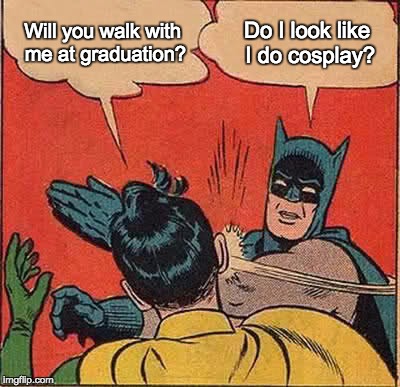
Posted on Facebook on March 1st, 2016. The meme represents a cross-over between the world of Batman memes and the real world, my world, of academia in both content and circumstance. It was occasioned by an email from my department chair to the faculty, asking (for a second time) for volunteers to go to an impending graduation ceremony at which philosophy students would be walking. To the best of my knowledge, neither the locution “walk with x at graduation” nor the suggested practice exists, but I needed a way to imply that Batman was expected to wear academic regalia and not merely be in the audience in his Bat-Civvies, so to speak, to watch Robin graduate.

In fact, the meme was was not just occasioned by my chair’s email. It constituted my reply-to-all to it. So in this sense, the cross-over between Batman and academia was not confined to the meme’s content. It was the first time in which there was a real connection between the Batman Meme Project and my academic world. It was also the first time I confronted my colleagues, en bloc, with evidence of the Batman Meme Project. (A couple were Facebook friends and may have seen some of the previous 20 memes I had posted there by that point.) Even though I had not yet fully conceived of the philosophical work that these memes would become a part of, sending the meme in an email to my colleagues was nonetheless a sort of  philosophical ‘coming out.’ So in a way, given its content and history, and the way they are intertwined, the meme epitomizes the entire book, A Certain Gesture: Evnine’s Batman Meme Project and Its Parerga!.

I remember, after I sent that reply-to-all, being a little apprehensive at the step I had taken. What would my colleagues make of my conducting departmental business with Batman memes? What would they make of the meme itself? Predictably, I need not have worried. No-one gave any acknowledgment of it at all. My meme fell still-born from the meme generator. Not a smile in the corridor (or smiley face in an email). Not an irritated “what?” Not a concern that I was having a midlife crisis. And now, here I am, joining in the silence by excluding the meme from the book. Am I trying to reassure my colleagues? “Don’t worry! That was an accident. Won’t happen again! Look, it’s gone!”

If the meme and its initial distribution somehow represent the collision between Batman memes and academic philosophy that the book as a whole embodies, its chilly reception by a bunch of philosophers anticipates the subsequent vicissitudes of my project. Somewhat to my surprise, as I have made parts of the project public and talked about it in various places, I have encountered a small amount of outright hostility and a much larger amount of what I would call “baffled indifference” (if that isn’t too much of a contradiction in terms).

I have, as you would expect, thought long and hard about the reaction my project elicits. I don’t think it is a result of wanting to use Batman memes in philosophy per se. I can imagine ways of using them that I guess would not get the same response. But the particular use I make of them is to heighten all the peculiarities and dissatisfactions that have attended my own trajectory through philosophy.  I won’t attempt a full accounting of those here. The book itself is for that. But super-briefly, I have not settled anywhere; my work has repeatedly shifted its focus and a number of papers are one-off interventions in areas I am not expert in. As a result of this, I have found I have had to struggle to be heard. As happens to all those who engage in this struggle, my voice has had to contort itself and express itself, finally, through acting out. A ‘slap’ delivered by email to my philosophical colleagues or underlying an experimental philosophical work is an utterance in the language of hysteria. And for those not highly attuned to it, the language of hysteria must always elicit baffled indifference.


OK, that’s two for two! Once again, what I have written about this meme makes me sorry that it is being cut from the book. But here is a case where it would have been much more difficult for me to write a commentary on these lines in the book, where the commentator is notionally distinct from the meme-maker. (More difficult, but perhaps not impossible, since I approach some similar issues in my commentary to another meme.)
Excisions: 1

I mentioned in a couple of previous posts that I decided to excise a number of the memes that were going to be part of my book. It was sufficient for a meme to be excluded that I did not envisage being able to write anything of interest (to me) in the commentary on it. I have now set myself the goal of posting the excised memes here, in an occasional series, and trying to write something of interest (to me) about them, thus proving my decision to exclude them mistaken! Also, in this parergonal space around the book, I will write about the memes without the pretense that their maker is someone other than myself. I am curious to see how this affects the nature of my writing about the memes.

TMI

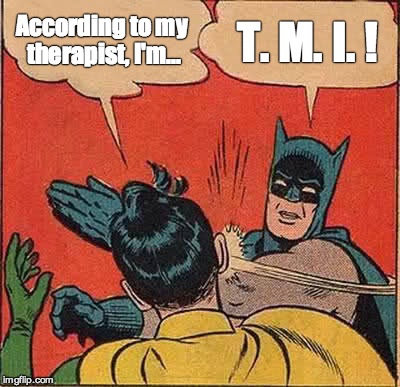
This was posted on Facebook on February 21st, 2016. It is the first of a group of memes that deal with being in analysis. (Mostly, in the memes, I use the term “analyst.” Here, for reasons I can no longer recall, I have used “therapist.” My preference for the term “analyst,” I fear, betrays a kind of seedy one-upmanship on my part – of which I am not proud! – as if to say, “I’m not talking about any old therapy but honest-to-goodness, genu-ine psychoanalysis.” I wonder if I wasn’t deliberately trying to slap down that tendency in myself by here going with “therapist.” Indeed, as I write this, I now feel I remember that very thought process.) I decided to omit the meme from the final tally because it is quite similar to, though not quite as good as, another, later meme. Continue reading “Excisions: 1”

The adventitious

In a philosophy paper I am presently working on, I lean heavily on the term “adventitious.” I say that the changes an ordinary artifact undergoes over time with respect to its parts are adventitious to it (and hence that a theory of such artifacts that ‘builds in’ these changes to an object’s identity is mistaken). I liked the term “adventitious” here but thought, mistakenly, that I was using it merely as a stylistic variant of “contingent.” I now think, in fact, that it gets at something deeper, or at least other, than contingency (though you’ll have to consult the paper, when it’s ready, to get a sense of what I’m gesturing at).

A few days ago I posted here about how I was re-thinking which memes would be included in my book A Certain Gesture: Evnine’s Batman Meme Project and Its Parerga!. The book, you could say, was undergoing an adventitious change in its parts. But I am made anxious by these changes. Not because I fear for the identity of the book. It is, in my mind, the very same book, only now with (slightly) different parts. I fear, rather, a different kind of loss.

How have I made the decisions about which memes to retain and which to remove? There are two ways a meme can keep its place. It must either be of sufficiently high quality itself or it must provide me with an occasion for some interesting commentary. While I feel fairly confident in my judgments of quality (only once or twice have I dithered over some meme, wondering if it is good enough for inclusion), I cannot tell, in advance of trying to write the commentary on it, whether a meme will occasion interesting commentary. And that is not an adventitious fact about the work. It is deeply central to what I am doing that I should be open to the adventitious in writing the commentaries. That is the process that underlies the work’s resemblance to the Wunderkammer, the Cabinet of Curiosities.

For example, take the commentary on the Yiddish meme which I have recently posted about three times. It is true that I did have some ideas of what I wanted to write about prior to starting on the commentary (some of which persisted into the final version and some of which did not), but it wasn’t until I wrote about a friend’s remark that the Romanization of the Yiddish gave the meme a “Lithuanian slant” that I took off in the direction of Lita (Jewish Lithuania), the Vilna Gaon, and my own Litvak ancestors. I ended up, quite spontaneously, composing a bibliography of these ancestors’ rabbinic works.

O9g4m

Continue reading “The adventitious”

The size of things: biz hundert un tsvantsik

When I first started on the book A Certain Gesture: Evnine’s Batman Meme Project and Its Parerga!, I thought to include all the memes (53) that I had posted on Facebook as part of the Batman Meme Project between January and March 2016 (including three that appeared only in the movie Evnine’s Batman Memes: The Movie that was the climactic finale of the Batman Meme Project). Among the parerga were to be six memes I had created at the same time but elected not to post on Facebook (there were others I excluded), and 61 memes I made subsequent to the Batman Meme Project. That made for a total of 120 in all.

I liked that the total was 120 (and determined on it even before finishing all the included post-project memes) for two reasons. First, it is the age by reference to which Jews wish on others a long life (biz hundert un tsvantsik, in Yiddish), in honor of Moses, who was 120 when he died looking over into the promised land he would never enter. Secondly, and perhaps more importantly, it is the number of the apartment in London in which I was born and in which I lived until, at 18, my parents did cross over into that promised land unattained by Moses, leaving me alone in London, effectively (like both Batman and Robin) an orphan. In a sense, you could say that my delivery was prolonged by 18 years, the apartment being a prosthetic uterus. (I often reflect on the fact that for various periods, my bedroom in that apartment was the very room in which I had been born.) It wasn’t until I was forced to leave no. 120 that I finally, fully, tumbled from fetal grace. That event must have been (I say “must have been” rather than “was” because I struggle to remember my feelings) experienced by me as, well… a slap in the face! (Not that my childhood before then was especially happy. But I was sheltered.)

Screen Shot 2018-08-03 at 2.42.06 PM

In any case, over time, I came to feel that some of the 120 memes were too weak to be included. I also created a few more which I was sorry would not find a place in the book. Finally, after much agonizing, and with the urging of the other University of Miami Center for the Humanities fellows last academic year, I decided to monkey about with the original selection, omitting and adding with the goal of getting the best memes and not trying to conform to this magical number, however personally significant it was for me. There are now going to be roughly 105 memes altogether. I think this is for the best, but I have to say that all of a sudden, the project feels somehow diminished to me. Not just because it has fewer memes in it. Rather, the work as a whole now seems to me less ambitious, less daring. Instead of the envisaged polyphonic texture, in which themes appear and re-appear, cutting across the division into discrete commentaries and the division between memes and commentaries, I now see a series of short essays interspersed with quite a few perfunctory commentaries in which I will have very little to say. Right now, the projected book strikes me as somewhat pitiful.

I am (fairly) sure this is just a phase and that I will eventually recapture something of the original, animating vision. All lengthy projects involve such phases, surely. The phases are the results of interferences between multiple currents. One current flows from the ‘oceanic feeling’ when the work is not fully formed and contains so much in potential to its birth as a diminished actuality. Another comes in bursts as new ideas unpredictably present themselves, new connections appear. A third involves the relinquishing of anxiety over whether one can actually do what one set oneself to do and a growing amazement at the real little fingers and toes that come into being. And all of these, of course, are superimposed on the currents of the rest of one’s life, with their own vicissitudes. Still, let no-one any longer wish me “biz hundert un tsvantsik.” That number is behind me, not ahead.

… in which I am called out (for humorously linking Batman and Yiddish)

In the on-going saga of my commentary on the Yiddish Batman meme, I mentioned, in my previous post, an ‘irascible’ expert who found the draft of the commentary I sent him to be riddled with errors. af a nar makht men nit kin peyresh, he said. (“One doesn’t write a commentary on a fool.”) It turns out that at that point, he had only skimmed what I had written. Now he has read it fully and things have gone from bad to worse, though the focus has shifted from my scholarly shortcomings to my ethical failures.

At one point in my commentary, recounting a little of the history of Yiddish, I write:

Starting in the second half of the 18th century, Jewish proponents of the Enlightenment began to stigmatize Yiddish as merely a debased form of German that kept its native speakers from accessing European high culture. The image of Yiddish as a comic, backward, folksy language began to take shape, in contrast to dominant European languages, on the one hand, and Hebrew, on the other – an image that even many subsequent supporters of Yiddish have been happy to accept.

In earlier versions of the draft, I then inserted a footnote in which I mentioned a recent exemplar of the “Yiddish supporter accepting the comic view of Yiddish” phenomenon, a book that starts with a joke about a kvetching Jew on a train and then says: “If you can understand this joke, you’ll have no trouble learning Yiddish.” (Because the essence of the language is the ability to kvetch in it, and knowing that smooths the way over all the bothersome conjugations, declensions, etc.) I noted that “such works appear to extoll the virtues of Yiddish, provided one forgets that the works of Cervantes, Swift, Marx, Einstein, Gilbert and Sullivan, Whitman, Dickens, Shakespeare, and Milton (to name just a few) were all translated into it.” At one point, I even mentioned, in studied proximity to this footnote, Sander Gilman’s book Jewish Self-Hatred. However, I removed both footnotes because the implication about the book I objected to was clearly offensive.

Continue reading “… in which I am called out (for humorously linking Batman and Yiddish)”

Becoming another

The idea for A Certain Gesture: Evnine’s Batman Meme Project and Its Parerga! was born with the impulse to (re)present the memes I had published on Facebook but with the explanations of their more esoteric aspects that I had purposely withheld the first time round. Thus, it was always going to take the form of memes with commentaries thereon. Something that was not built into that very idea, but that fairly quickly took hold of me, was that the commentaries should be written as if by someone other than the creator of the memes.

Why did I make this fateful decision? The whole character of the work is profoundly different from what it would have been had I written about the memes ‘in the first person’ and yet I hardly know why it felt so right to me to do it this way. In 1710, somebody said: “This was, among the ancients, that celebrated Delphic inscription, ‘Recognize yourself!’, which was as much as to say ‘Divide yourself!’ or ‘Be two!'”¹ Was the division of myself performed in unconscious obedience to a demand for self-knowledge? Certainly the project as a whole has been connected to the progress of my psychoanalysis, which is an extended exercise in gaining self-knowledge – but has that quest been abetted by my decision to “be two” in this work? Or has that decision served to help me keep my own counsel under the scrutiny of an over-inquisitve commentator? Both, is the likely answer.

The general form of the challenge raised by my self-division is this. A meme, to be comprehensible, must be supplied with context concerning my own life, thoughts, activities, or writings. The ‘editor,’ being ‘distinct’ from the creator of the memes, does not have automatic access to those elements of context that are not, in principle, accessible to anyone. How, therefore, can he introduce them into his commentary on that meme? I have employed a variety of different solutions to this common problem, ranging from manufactured (i.e. fake) documentary evidence to imaginative recreations of the artist’s state of mind on the editor’s part.

In attempting to solve this common problem again and again, now in one way, now in another, I have come to have the strangest experience. The memes on which I am commenting were produced about two years ago. (Yes, time really does fly.) As they recede further and further into the past, they really do come to appear to me as the work of another! In some cases, I no longer remember what I was thinking or what I meant. The fictional split between the artist of the memes and the editorial author of the commentaries is gradually becoming a reality in a way I had not anticipated. Perhaps, if the preparation of the book takes enough time, I will truly come to forget what some of the memes are about, or even whether I created them at all.

¹ The somebody was in fact the Earl of Shaftesbury, in section 2 of his Soliloquy: Advice to an Author.

Other voices

I have previously indicated that the spirit of W.G. Sebald’s The Rings of Saturn hovers over my own efforts in A Certain Gesture: Evnine’s Batman Meme Project and Its Parerga!. I first read the Sebald six or seven years ago. In the course of his loosely connected, almost free associative, wanderings from one reflection on death and destruction to another, he describes a visit to Somerleyton, the seat of an unlikely magnate from the nineteenth century, now a crumbling cabinet of curiosities in which a guided tour takes one through rooms of bygone paraphernalia. A camphorwood chest which may once have accompanied a former occupant of the house on a tour of duty to Nigeria or Singapore now contains old croquet mallets and wooden balls… The walls are hung with copper kettles, bedpans, hussars’ sabres, African masks, spears, safari trophies, hand-coloured engravings of Boer War battles… Nor can one readily say which decade or century it is, for many ages are superimposed here and coexist… How fine a place the house seemed to me now, continues Sebald, that it was imperceptibly nearing the brink of dissolution and silent oblivion.

In order to avail myself of its riches in the execution of my own current project, I recently started to re-read Sebald’s work – with some trepidation, since time leaves nothing unaltered. And indeed my experience of it has been rather different. On my first reading, I recall being enveloped by a single sustained mood, utterly enchanted. Now, owing perhaps to the somewhat difficult circumstances in which I have been re-encountering Sebald’s melancholy ramblings, my experience has been highly fragmented. I have learnt to recognize, and hence occasionally be irritated by, some of his mannerisms. Parts of the book have moved me nearly to tears while other parts have felt forced and predictable. I have little doubt that the differences here come from me and do not reflect substantial variations in the quality of Sebald’s writing.

One mannerism, which I had either not noticed on my first reading or else had forgotten about, is the way in which Sebald mentions a work by some other writer and then begins, without any warning (and hence without the use of quotation marks), to quote from it. One does not always realize this is happening until one runs into the use of a personal pronoun which is clearly the original author’s and not Sebald’s. At this juncture, Sebald will insert text into the quotation that alerts the reader to the dislocation of the personal pronoun, as I did two paragraphs above.

I had determined that I would use this technique to incorporate some of Sebald’s own book into the commentary on a meme that refers to Sir Thomas Browne, who himself is the subject of some of Sebald’s reflections and whose own spirit evidently infuses his work.

number5
Meme that refers to Sir Thomas Browne
Browne2
Edition of Sebald’s The Rings of Saturn at an exhibition on Browne

How thrilled I was, then, when a friend and student, Ted Locke, suggested that I read a paper by the literary scholar Jane Tompkins called “Me and My Shadow.” Ted and I have discussed auto-theory off and on for over a year. Tompkins’s paper is an early manifesto of auto-theory. In it, she expresses a frustration with academic writing and a desire somehow to incorporate a more personal element into her work that exactly reflects (or I should say, preflects, since her essay was published in 1987) my own motivations for and aspirations in A Certain Gesture: Evnine’s Batman Meme Project and Its Parerga!. Having referred to Ursula Le Guin’s distinction between father tongue (which only lectures) and mother tongue (which expects an answer), she goes on to say:

I find that having released myself from the duty to say things I’m not interested in, in a language I resist, I feel free to entertain other people’s voices. Quoting them becomes a pleasure of appreciation rather than the obligatory giving of credit, because when I write in a voice that is not struggling to be heard through the screen of forced language, I no longer feel that it is not I who am speaking, and so there is more room for what others have said.

Sebald’s murmuring prose does exactly what Tompkins seeks to articulate in her essay; it blends the impersonal historical with the personal, it seamlessly incorporates other voices, and it never struggles to make itself heard through forced language. This incorporation of other voices makes his work itself a cabinet of literary curiosities – a work in which one cannot tell what decade or century it is, in which one is as likely to find oneself conjecturing about Sir Thomas Browne’s attendance at a scene depicted by Rembrandt as on the childhood of Conrad, or on the death of Edward Fitzgerald, whose translations of Omar Khayam are so distinctive that they have passed into the English language as something generic –  just one of the many ways English can be – in the way that the King James translation of the Bible has. I have yet to finish my second reading of The Rings of Saturn but the frustrations of my re-reading of its earlier parts will, I feel sure, be entirely reconfigured, and perhaps disappear altogether, owing to Tompkins’s invigorating essay. And for anyone keeping track, you might have noticed that I have been silent on my blog for some time now – this post, “Other voices,” is the first new parergonal material I have been able to create for quite some time.

M.1 “… a meme in which I’m being…”

Some time ago, before I started the dedicated Facebook page which turned into this blog, I posted several excerpts from my book-in-progress. Now I have this blog, I thought I would re-post them here. The first one I posted was the first Batman meme I ever made and will be the first in the book, accordingly. I re-reproduce it below, as close as I can to how I envisage it on the printed page. I now think, however, that the treatment of the philosophical issues in the antepenultimate paragraph is inadequate and will need to be rewritten at some point.

M.1 … a meme in which I’m being…

Picture1


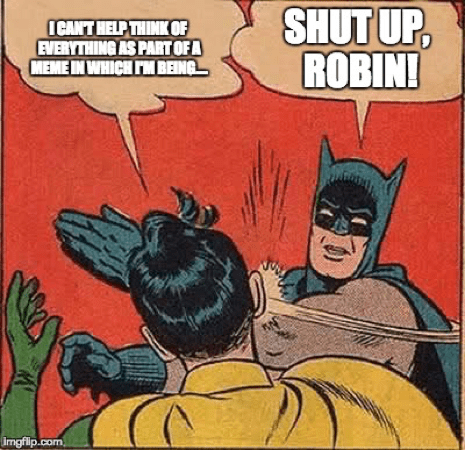
M.1: … a meme in which I’m being…  Composed: January 27th. Posted: January 27th. Orientation: Reverse. Font: Impact, with font shadow. TB1: “I can’t help think of everything as part of a meme in which I’m being…”, white, with black borders. TB2: “Shut up, Robin!”, white, with black borders.


The technique of this, as of all the earliest memes (M.1-M.4), is crude. The default settings of the meme generator used by the artist (Impact font, with font shadow, all capitals, white letters with black borders) are left in place, almost certainly because at that stage, he did not realize they could be changed. They are highly unsuitable settings where there is a lot of text (see the technically disastrous M.3). Even here, where there is not that much text, Robin’s words are quite hard to make out.[1] Continue reading “M.1 “… a meme in which I’m being…””

Challenges

One of the things I have most appreciated about working on A Certain Gesture: Evnine’s Batman Meme Project and Its Parerga! is the way it has forced me to be creative when I have had to talk about the work or present it to people in formal or semi-formal settings. Very difficult, and not so rewarding, has been the presentation of the project in applications for sabbaticals, fellowships, and funding (with variable results!). This is, of course, because such presentations are petitions and one cannot stray too far from the traditional forelock tugging in making one’s petitions.

Much more rewarding have been the presentations made to people without goal of profit – in universities and private homes. The peculiar nature of the project, and its unsuitability to exposition in anything like a normal academic format, has flummoxed me right from the start and has thereby forced me to be creative in unexpected ways. Generally, I have had to make my presentations a performance. I suppose all academic presentations involve some element of performance, but in these cases, I really had to go way beyond my comfort zone, in both presentation and content. I have had, in my own limited way, to mug for the audience (something I detest usually), to act a part, and to embarrass myself by personal exposure. (Not of the taking off of one’s clothes variety!)

Continue reading “Challenges”

…book-ends, or parentheses…

Earlier this summer, I went to meet a distinguished Israeli psychoanalyst, M.. I traveled by train from Herzeliya, where I was staying with my brother, and walked from the station in Tel Aviv to M.’s office, about a mile and a half away. The purpose of my visit was to discuss with M. the possibility of giving a presentation to psychoanalysts in Israel about my book-in-progress, A Certain Gesture: Evnine’s Batman Meme Project and Its Parerga!. The book defies easy description; it is a strange, genre-crossing work that mixes graphic art, self-writing, and philosophy (understood in a very broad sense). I was to explain to him what the connections were between my book and psychoanalysis, connections which I was sure existed and about which I was prepared to talk fluently. M. is a little older than me and of course a very experienced psychoanalyst as well as a very knowledgeable philosopher.

Perhaps you can imagine how this felt. I am myself in analysis and I was acutely aware, as I entered M.’s office, that this was a place where psychoanalysis was conducted. The office was small, but there was the iconic couch in it. And two chairs, into one of which M. ushered me, stating (quite unnecessarily, you can be sure!) that this was the ‘patient’s chair.’ I was petitioning this older man for the chance to address a group of analysts. Petitioning this man who was vastly more knowledgeable about one of the subjects I wanted to speak about than I am; this man who was an analyst, in his own office, while I sat in what we had openly acknowledged was the patient’s place, but who even before entering the office was already investing this meeting with a lot of transferential feelings (as if it were a chance to have a friendly chat with my own analyst). If you guess that these were not propitious circumstances for me, you will not be wrong. Continue reading “…book-ends, or parentheses…”