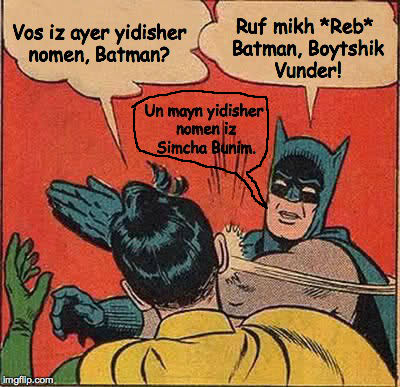
I have posted several times about my Yiddish Batman meme in my book A Certain Gesture: Evnine’s Batman Meme Project and Its Parerga!. One of those posts (“Shmidentity Politics,” about Kripke’s coinage of the term “schmidentity” – the discrepancy in spelling between the name of my post and Kripke’s coinage is significant) includes text that is incorporated into a footnote to a footnote to a footnote to the commentary on that meme. Here, lightly edited to stand alone, is the middle footnote in the chain, the one to which “Shmidentity Politics” is a footnote.
A paper by David L. Gold bears the title “A Story about Pocahontas, Geronimo, and Sitting Bull in Yiddish” (1983)… It involves a father “dzheronevits” (Geronimo), a mother “pokeyente” (Pocahontas), their daughter “mine-horevits” (Minnehaha), along with “siting-bulvan” (Sitting Bull), and “meshugn-ferd” (Crazy Horse). Two indigenous tribes are mentioned: “shvarts-fusike” (Blackfeet) and “shmohoker” (Mohawks). Gold calls these names “Yiddishizations” or “partial Yiddishizations.” (Of course, what they are (partial) Yiddishizations of are probably not the original names in indigenous languages but the Anglicizations (or possibly, depending on the story’s origins, the Russifications, or Polifications, or Germanifications) of those originals. The Yiddishizations work both by translation (“meshugn-ferd” for “Crazy Horse”) and assonance (“dzheronevits” for “Geronimo”), two relations, as we have seen, that often relate a kinuy [secular name] to a shem kodesh [Jewish, or holy, name]. [The relation between Jewish and secular names is a main theme of the meme and the commentary on it.]) Gold says the story is about Pocahontas, Geronimo, and Sitting Bull. But Pocahontas and Geronimo were not married, lived in different centuries, thousands of miles from each other, and did not have Minnehaha (a fictional character) as a daughter! Does the story really say of them that they were and did? Other than being indigenous Americans, there is no resemblance at all between the characters in the story and the people Gold says the story is about.
Robin Jeshion (2002) has emphasized the way in which proper names, as such, can enable thought and talk about their bearers (de re thought and talk, to use the philosophical jargon), regardless of which features those bearers are represented as having or not having. (See the commentary on M.29 (Who Knows Two?) for an account of Jeshion’s views on this matter.) Jeshion draws on Saul Kripke’s seminal work (1980) according to which names are generally bestowed on things in acts of naming and then passed along through historical chains that allow later people to refer to the original bearers of the name despite possibly having no direct access to them. Gold’s claim that the Yiddish story in question is about Pocahontas, etc., is a good case study. For while, we may suppose, there were historical links between the Yiddish names in the story and the original names of the people referred to by Gold in his title, the story itself does not use those bestowed names but rather names that might be considered to be different, though resembling, names. Gold’s claim about the story’s subject matter shows that a view like Jeshion’s really must work hand in hand with an account of the identity of names. When are two variants considered forms of the same name and when of different names? And conversely, reflection on the philosophy of proper names shows that a claim like that in Gold’s title must really be offered only with great caution. It is not at all uncontroversial to say that the story in question is about Pocahontas, Geronimo, and Sitting Bull.
 Simon J. Evnine