It’s so hard, Batman!

Lately, several people have indicated to me that they would like to read my forthcoming book, A Certain Gesture: Evnine’s Batman Meme Project and Its Parerga!, but they are worried it will be too difficult to understand. With its publication imminent, it feels like a good time to address this concern. Some theorists have held that literary works are really about how to read them. Since much of my book is about difficulties in reading, writing, speaking, and understanding, it may have some help give with how to approach it.

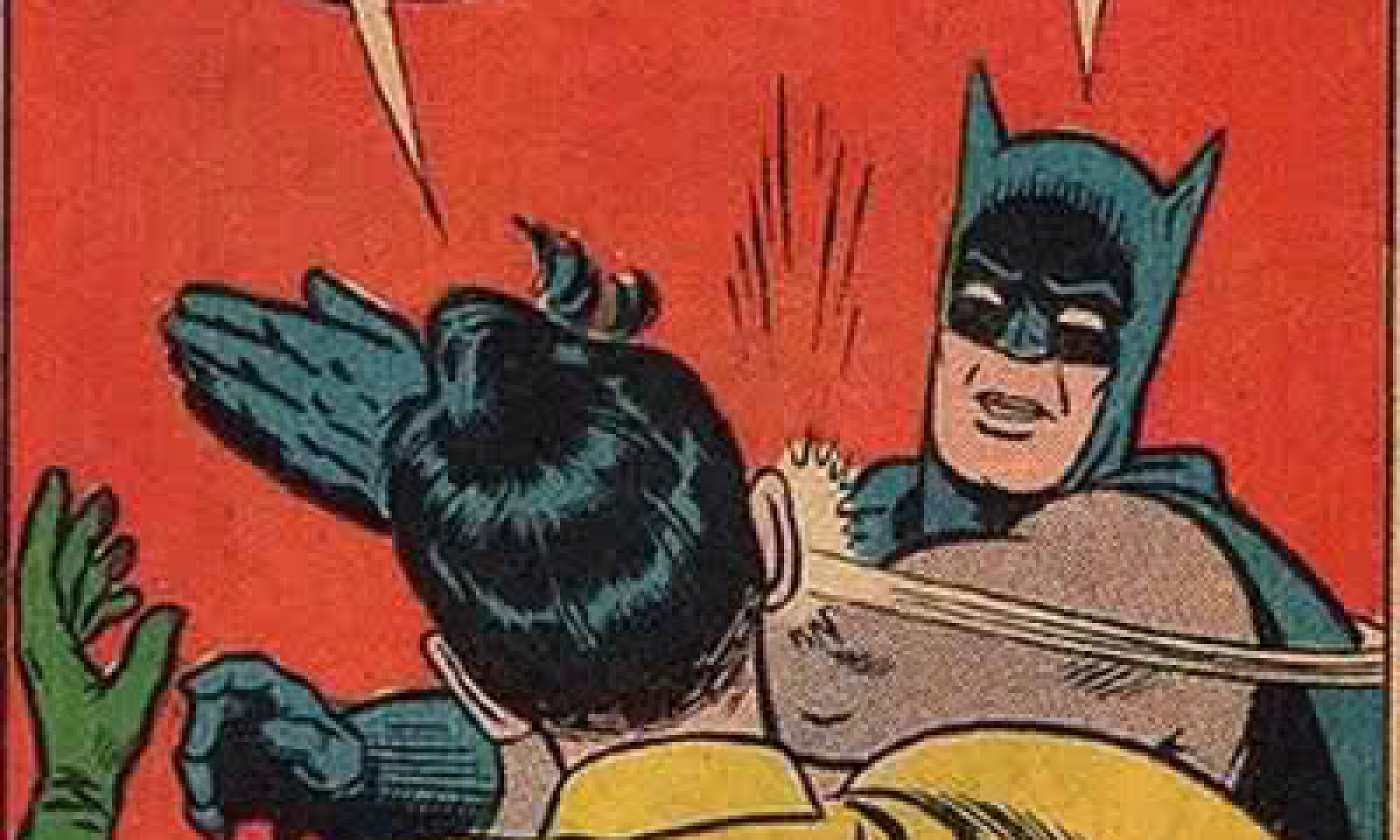
This meme, which will be the subject of a long commentary in volume I, is about free association in psychoanalysis. One way to read the book is to think of it as an extended exercise in free association on the part of its author. How does, or should, an analyst listen to a patient’s free association? Freud recommended an evenly-suspended attention. More radically, Bion suggested the analyst should be present “without memory or desire.” These descriptions suggest a lightness and immediacy in relation to the text, not getting snagged on things one doesn’t understand, letting go of preconceptions about what our response ought to be. The reader just needs to open herself to the text as it reaches her. More recent trends in psychoanalytic listening emphasize the role of the analyst’s own fantasies in response to the patient’s words. In this vein, my book can be approached as a stimulus to the reader’s own associations, the reader and the text creating a unique, third thing between them.

Another meme, sadly not included in volume I, alludes to the words of the seventeenth-century polymath Sir Thomas Browne. Browne’s sensibility is captured by the image of the cabinet of curiosities and this, in turn, suggests a different way of accessing the book. The reader may simply stroll through the collection of weird exhibits, passing quickly by those that do not hold her interest but lingering over those that do. Not every commentary will catch everyone’s interest. None may be universally interesting. But I hope, and believe, that in the eccentric collection of so many oddities that is my book, everyone will be able to find something or some things to interest her.

A final way of approaching the book is suggested by this meme, which will be in volume I and the commentary on which will explicitly touch on these issues. “Listen to my words!” Trust the author to take care of you and follow along with him, in a relaxed frame of mind, just taking the text at face value. As I explained in another post, I have been frequently praised for my clarity of expression. Where topics are potentially hard to grasp, I have done my best to make them clear. Although I will certainly fail in this at times, don’t let anxiety get in your way and you may find things easier to understand than you were worried they would be.

So, there are three different ways of reading the book. Of course, they can be picked up and discarded at will for different parts of the book. You don’t get to choose just once. But above everything, have fun with it! That’s what it’s there for!
That is not it, at all: clarity and sadism

That is not what I meant at all;
               That is not it, at all.
T.S. Eliot
 
Throughout my philosophical career, one virtue my writing has been consistently praised for is its clarity. Just about every journal referee and every book reviewer has used that very word or one of its cognates. Not its profundity, not its wisdom, not how interesting it is. It’s always clarity, clarity, clarity. And I’m OK with that. I value clarity very highly. Moreover, my discipline, analytic philosophy, is founded on and built around the quest for clarity so my personal virtue is syntonic with the standards of my profession.
 
But things have been shifting for me lately and, without revoking my approval of clarity, I have come to see it also in other ways. Part of writing clearly is anticipating, and forestalling, potential ambiguities, misunderstandings, and irrelevant but tempting byways. Clear writing, in other words, serves to direct the reader’s thought along exactly the path the author wishes. I would put it in even stronger terms. Clear writing is designed to occupy the reader’s mind, to colonize it, forcing it to renounce its freedom and follow slavishly the writer’s direction of thought.
 
Deploying a psychoanalytic concept developed by Melanie Klein and her followers, clarity in writing seems to me to be a mechanism of projective identification. Here is part of the definition of projective identification from the New Dictionary of Kleinian Thought (2011):
 

Projective identification is an unconscious phantasy in which aspects of the self or an internal object are split off and attributed to an external object.

The projected aspects may be felt by the projector to be either good or bad. Projective phantasies may or may not be accompanied by evocative behaviour unconsciously intended to induce the recipient of the projection to feel and act in accordance with the projective phantasy.

In analysis, the patient projects parts of their mind into the analyst and then, subtly and unconsciously, strives to get the analyst to act in conformity with it. If the patient, for example, has aggressive and sadistic phantasies they cannot assimilate, they will attempt to elicit aggressive and sadistic behavior from the analyst. It is both a dangerous and valuable game.

Clear writing, too, is aggressive and sadistic – not in its content but in the domination it attempts. The reader is ‘forced’ to look here and not there (where their own phantasies might take them), to disregard this but to give that a lot of weight, to understand something polysemous in one way and not another. I imagine that what is being projected through this mechanism is the writer’s own anxiety, anxiety about confusion, about uncertainty, about getting lost, about being swallowed up by a messy, stinking pile of conceptual detritus. Writing clearly makes the writer work hard to control what they produce and at the same time, disallows anyone else the freedom to just let it all go.

I, certainly, whose care and intellectual hygiene so routinely earns me praise from my readers, am beset by these anxieties.†

My book-in-progress, A Certain Gesture: Evnine’s Batman Meme Project and Its Parerga!, exhibits my internal struggles around these issues. I have sometimes said that a key way of understanding its organization is through the analytic concept of free association. Free association is a mode of talking which deliberately tries to set clarity aside. As in free association, so in my book, one thing leads to another not through linear logic but through chance associations, phantasy, and play. The book as a whole does not ‘add up to anything.’ Not making any point, it cannot have a telic structure. It can be read in any order. The emphasis placed on the parergon means that the work is not even sharply divided from what lies outside it. ‘The work’ barely exists at all. What could be messier than a work that cannot be distinguished from its frame? Or even from its didactic?

Concurrently with work on my book, anxieties about free association in analysis have been gradually soothed so that now, after 8 years, I finally find myself occasionally able to talk freely. It’s a great feeling.‡ I look forward, too, to writing philosophy that is no longer ‘clear’ but manages to be interesting or profound instead.

† I have written here about my horror of things like nonsensical words in children’s songs .

‡ Anton Kris, in his book Free Association: Methods and Process, emphasizes the effect of free associating on the patient’s well-being.

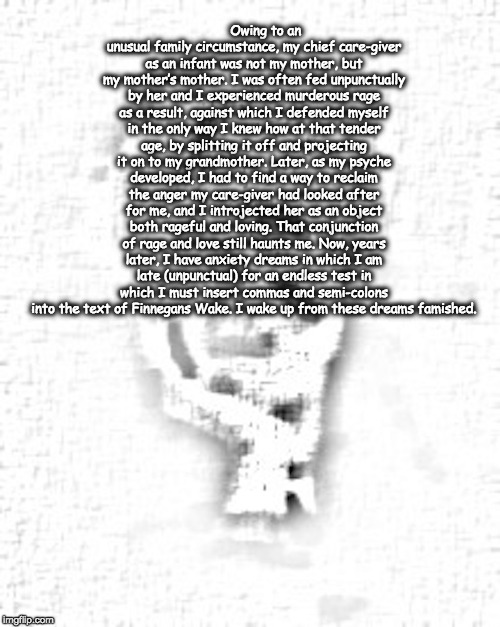
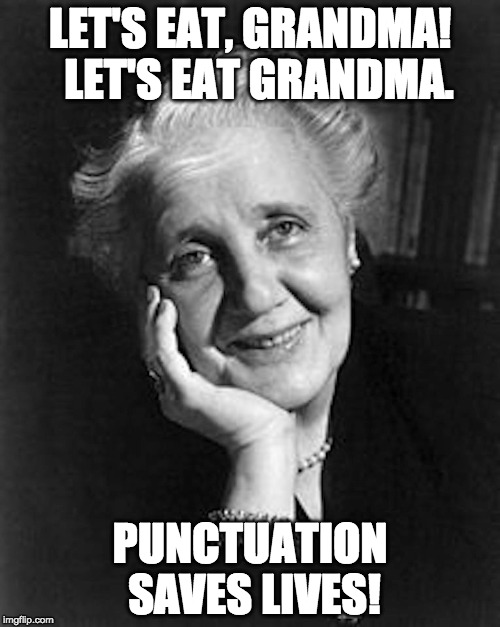
An Increasingly Verbose meme. A grandmotherly Melanie Klein becomes sketchier as the jokey example used to illustrate the importance of proper punctuation becomes more verbose and, in the final panel, more Kleinian.