Quotation, camp, and Lagadonian languages

In my previous post, I wrote about proper names versus descriptions and how that issue is inscribed in the world of Batman from the character’s very first appearance in 1939.

Another theme that will loom large in my books, and that also is prefigured in the very first appearance of Batman, is the use and nature of quotation marks. Some of my memes will derive their humor (or ‘humor’) from how quotation marks interact with punctuation, and from words appearing both within and without quotation marks in the same sentence. Quotation marks are one of the primary means we have in English (and in many other languages) for referring to language itself. At least on the face of it, they provide a simple and standard way by which we can refer to any bit of language – simply take that bit of language and put quotation marks around it. We will thus establish instances of the schema: Continue reading “Quotation, camp, and Lagadonian languages”

M.1 “… a meme in which I’m being…”

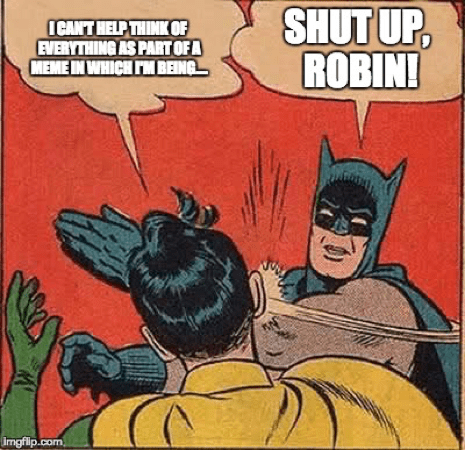
Some time ago, before I started the dedicated Facebook page which turned into this blog, I posted several excerpts from my book-in-progress. Now I have this blog, I thought I would re-post them here. The first one I posted was the first Batman meme I ever made and will be the first in the book, accordingly. I re-reproduce it below, as close as I can to how I envisage it on the printed page. I now think, however, that the treatment of the philosophical issues in the antepenultimate paragraph is inadequate and will need to be rewritten at some point.

M.1 … a meme in which I’m being…

Picture1


M.1: … a meme in which I’m being…  Composed: January 27th. Posted: January 27th. Orientation: Reverse. Font: Impact, with font shadow. TB1: “I can’t help think of everything as part of a meme in which I’m being…”, white, with black borders. TB2: “Shut up, Robin!”, white, with black borders.


The technique of this, as of all the earliest memes (M.1-M.4), is crude. The default settings of the meme generator used by the artist (Impact font, with font shadow, all capitals, white letters with black borders) are left in place, almost certainly because at that stage, he did not realize they could be changed. They are highly unsuitable settings where there is a lot of text (see the technically disastrous M.3). Even here, where there is not that much text, Robin’s words are quite hard to make out.[1] Continue reading “M.1 “… a meme in which I’m being…””

Names and descriptions

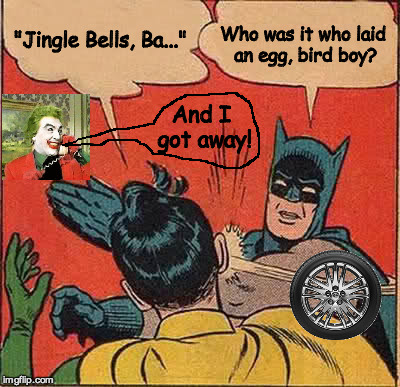
When I composed the bulk of my Batman memes, between January and March 2016, I knew very little of Batman except the 1960s TV series, which I loved and which defines the characters of Batman and Robin for me. (One of the memes uses the image of the Joker, as played by Cesar Romero

jingle-bells

and another that of Burgess Meredith’s Penguin.) In preparing to write my book A Certain Gesture: Evnine’s Batman Meme Project and Its Parerga!, I thought I should rectify that and so I was happy to find a recent book had been published on the history and cultural significance of the various incarnations of Batman – The Caped Crusade: Batman and the Rise of Nerd Culture, by Glen Weldon. From that book, I learned that several of the themes I will deal with in my book are in fact pre-figured in the Batman corpus from the very beginning.

Continue reading “Names and descriptions”

Tweets and memes

Last weekend, I opened a dedicated Twitter account to go with this blog – essentially as a way of informing people that there are new posts. But the involvement of Twitter in the epitextual writings around my book-in-progress, A Certain Gesture: Evnine’s Batman Meme Project and Its Parerga!, also brings to the fore elements of the project that I have long been thinking about.

It came to me, during the heyday of my production of Batman memes in early to mid 2016, that the memes themselves were a little like tweets. That inspired me to make one meme, which I will not display here since I have to hold back a few good ones for the appearance of the book, in which Robin’s text is in the form of a tweet, #s and @s and all.

The resemblances stem from, though exceed, the limits to the amount of text one can use in both. With Twitter, the limit is hard and clear – 140 characters. With memes, the limit is what can be legibly imposed on the image. This is true for all image macro memes, but with Batman Slapping Robin, there is even less space than usual in the image  available for text, if one wants to include all the text in the speech bubbles. I frequently struggled to pare down the text I wanted to use to one I could make legible. A few memes just could not be pared down enough and I had to resort to other measures. In this meme (M.29 “… he was a jew,” published on Facebook on March 7th 2016), I both strained legibility almost to breaking point and overflowed the bounds of the speech bubble:

ulysses-third-version

Continue reading “Tweets and memes”

{ !?!? } / { } !?!?

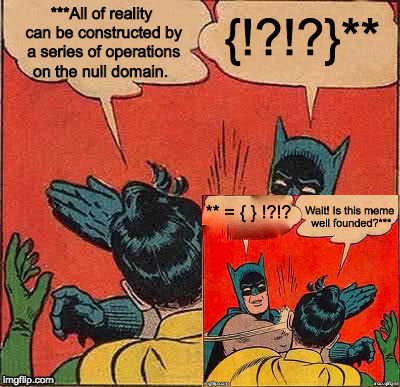
In my previous post, I included an animated gif which used three panels: an initial one which occupies the full space of the image, and two others which appear, one after the other, inside the larger one. (The larger one does undergo some change of its own, too, when the smaller ones are embedded.) The smaller, embedded panels function as ‘footnotes.’ When the second of the two smaller panels is embedded, Batman’s text in the larger panel reads ” { !?!? }**” and his ‘footnoted’ text in the embedded panel reads “** = { } !?!?”.

parentheses3

Continue reading “{ !?!? } / { } !?!?”

…book-ends, or parentheses…

Earlier this summer, I went to meet a distinguished Israeli psychoanalyst, M.. I traveled by train from Herzeliya, where I was staying with my brother, and walked from the station in Tel Aviv to M.’s office, about a mile and a half away. The purpose of my visit was to discuss with M. the possibility of giving a presentation to psychoanalysts in Israel about my book-in-progress, A Certain Gesture: Evnine’s Batman Meme Project and Its Parerga!. The book defies easy description; it is a strange, genre-crossing work that mixes graphic art, self-writing, and philosophy (understood in a very broad sense). I was to explain to him what the connections were between my book and psychoanalysis, connections which I was sure existed and about which I was prepared to talk fluently. M. is a little older than me and of course a very experienced psychoanalyst as well as a very knowledgeable philosopher.

Perhaps you can imagine how this felt. I am myself in analysis and I was acutely aware, as I entered M.’s office, that this was a place where psychoanalysis was conducted. The office was small, but there was the iconic couch in it. And two chairs, into one of which M. ushered me, stating (quite unnecessarily, you can be sure!) that this was the ‘patient’s chair.’ I was petitioning this older man for the chance to address a group of analysts. Petitioning this man who was vastly more knowledgeable about one of the subjects I wanted to speak about than I am; this man who was an analyst, in his own office, while I sat in what we had openly acknowledged was the patient’s place, but who even before entering the office was already investing this meeting with a lot of transferential feelings (as if it were a chance to have a friendly chat with my own analyst). If you guess that these were not propitious circumstances for me, you will not be wrong. Continue reading “…book-ends, or parentheses…”

Batman slapping Robin, live!

I just gave a version of my presentation on A Certain Gesture: Evnine’s Batman Meme Project and Its Parerga! at a salon in London. The lack of technology available meant that I could not project images – so I resorted to having some of the memes acted out, by Oliver Black and Jenny Black! As I explain in the video of that small portion of the talk, I attempted to turn that to advantage by choosing memes that lost something important by being enacted.

Some thoughts on onomastic fetishism

As you may know if you’ve followed anything about my current project, A Certain Gesture: Evnine’s Batman Meme Project and Its Parerga! will be presented as a catalogue of Evnine’s (my) Batman memes by an editor who is, as I have started putting it, notionally distinct from the creator of the memes. That is, the editor will write about the artist in the third person, will conjecture about him and his motivations, will draw on evidence to substantiate those conjectures, etc. But I will not conceal the fact that the artist and editor are in fact the same person.

I am now reading Gerard Genette’s book Paratexts: Thresholds of Interpretation and one of the paratexts he discusses is the author’s name. And as it happens, I have wondered for some time how this will work in my book. The full title is A Certain Gesture: Evnine’s Batman Meme Project and Its Parerga!. I had initially thought that that the ‘authorship’ of the book would take the form “edited by Simon J. Evnine.” But a doubt about this way of proceeding arose from the crassest of material concerns. Would a university administrator see “edited by” and count the book less towards future pay raises than an authored monograph? Should I, to lay claim to my work, follow the title simply with “by Simon J. Evnine”?

Genette distinguishes between mere pseudonymity and the creation, by an author, of a genuine alternative, imaginary author, replete with her own paratextual presence (prefaces, honors, etc), as, for example, is the case with Kierkegaard. In my own case, there is no pseudonymity involved, but something of the same problem of classification arises. Have I, with paratextual repletion, created two personae here, both of whom share my name? Or is there a mere “onymity” (the term Genette coins to refer to the standard case in which an author uses her own name), but with some weird stuff added in which I refer to myself in the third person?

On top of it all, naming itself is one of the themes that will run through the work. Genette writes that “use of a pseudonym unites a taste for masks and mirrors, for indirect exhibitionism, and for controlled histrionics with delight in invention, in borrowing, in verbal transformation, in onomastic fetishism” (52-3). Perhaps the moral to be drawn from my own case is that all of this is true for the use, not just of a pseudonym, but of any name, even one’s own. I am certainly planning for my book to engage in all those things Genette lists.
I didn’t say “I approved”!

I am easing gently into presenting A Certain Gesture: Evnine’s Batman Meme Project and Its Parerga! (and the ideas around it) in live academic contexts. A few weeks ago, in a session on memes as literature, I spoke for a few minutes about it in my undergraduate Philosophy of Literature class. Yesterday, as I said on this page just before the event, I presented it in a more deliberate way, with a 20 minute or so presentation, to visiting prospective graduate students in my department. I was happy with my performance and I think the response was mostly positive.

A number of my colleagues were there too! This was particularly significant to me since so much of both the form and the content of the project (as I hinted at in my presentation) is driven by my own feelings about my place in the profession. Some of my colleagues were very enthusiastic; some looked disapproving; one of them said later that it was very interesting and when I said “I’m glad you approved,” sharply replied “I didn’t say I approved!”

glad-you-approved

Skin in the game

Following up on my previous post about cumulative songs and naming… A Certain Gesture: Evnine’s Batman Meme Project and Its Parerga! is a work of auto-theory. To see how the pros do auto-theory, I recently read Maggie Nelson’s fantastic book The Argonauts. She speaks very frankly about many things in it (including sex) and I sort of realized that to make my book credible as a work of auto-theory, I was going to have to put some “skin in the game” and be prepared to write about embarrassing personal things.

That is why I decided to reveal the multitude of pet names I gave a previous cat of mine, Celestino.

But seriously, I had not fully anticipated, when I began this project, how much I would have to confront issues of self-revelation. And, since the form of the book is commentary on the memes by a notionally distinct editor, how self-revelation will work when it is presented through that indirection.

And then, this morning, I saw a post by Skye Cleary in which she refers to a film about Derrida in which he complains that philosophers don’t write about their sex lives! I imagined how that would go, in an article in Mind or Synthese:

“x is an ORGASM[subscript: philosopher’s name] if and only if a)…. b)… c)…. This definition is both too broad and too narrow. Regarding b), I have often found myself…. The problem with c) is that it would make it impossible, by definition, for anyone other than me to experience an ORGASM[subscript: philosopher’s name]. But while I think that it is metaphysically impossible for that to happen, it is not conceptually impossible. We might therefore weaken c) to c’)… ”

Rest assured: whatever happens in A Certain Gesture, it will not look like that!!!!