The book is finally here!

Hi everyone. My book, A Certain Gesture: Evnine’s Batman Meme Project and Its Parerga!, is finally finished and published! It is available from Amazon here.

It would be really wonderful if you would think about reviewing it on Amazon itself, on Goodreads (if you’re there), or in any other fora where it might be appropriate. As a self-published work, it will need all the help it can get!

If you are unable to get hold of it or cannot afford it or just don’t feel like paying for it, get in touch with me and I will be happy to send you a free PDF of it.

Thank you for your support through this journey. I will continue to blog here about its reception and any other thoughts or ideas I have about it.

It’s so hard, Batman!

Lately, several people have indicated to me that they would like to read my forthcoming book, A Certain Gesture: Evnine’s Batman Meme Project and Its Parerga!, but they are worried it will be too difficult to understand. With its publication imminent, it feels like a good time to address this concern. Some theorists have held that literary works are really about how to read them. Since much of my book is about difficulties in reading, writing, speaking, and understanding, it may have some help give with how to approach it.

This meme, which will be the subject of a long commentary in volume I, is about free association in psychoanalysis. One way to read the book is to think of it as an extended exercise in free association on the part of its author. How does, or should, an analyst listen to a patient’s free association? Freud recommended an evenly-suspended attention. More radically, Bion suggested the analyst should be present “without memory or desire.” These descriptions suggest a lightness and immediacy in relation to the text, not getting snagged on things one doesn’t understand, letting go of preconceptions about what our response ought to be. The reader just needs to open herself to the text as it reaches her. More recent trends in psychoanalytic listening emphasize the role of the analyst’s own fantasies in response to the patient’s words. In this vein, my book can be approached as a stimulus to the reader’s own associations, the reader and the text creating a unique, third thing between them.

Another meme, sadly not included in volume I, alludes to the words of the seventeenth-century polymath Sir Thomas Browne. Browne’s sensibility is captured by the image of the cabinet of curiosities and this, in turn, suggests a different way of accessing the book. The reader may simply stroll through the collection of weird exhibits, passing quickly by those that do not hold her interest but lingering over those that do. Not every commentary will catch everyone’s interest. None may be universally interesting. But I hope, and believe, that in the eccentric collection of so many oddities that is my book, everyone will be able to find something or some things to interest her.

A final way of approaching the book is suggested by this meme, which will be in volume I and the commentary on which will explicitly touch on these issues. “Listen to my words!” Trust the author to take care of you and follow along with him, in a relaxed frame of mind, just taking the text at face value. As I explained in another post, I have been frequently praised for my clarity of expression. Where topics are potentially hard to grasp, I have done my best to make them clear. Although I will certainly fail in this at times, don’t let anxiety get in your way and you may find things easier to understand than you were worried they would be.

So, there are three different ways of reading the book. Of course, they can be picked up and discarded at will for different parts of the book. You don’t get to choose just once. But above everything, have fun with it! That’s what it’s there for!

Kierkegaard meets Calvino meets auto-theory

It looks as if I am going to be publishing the first volume  of A Certain Gesture: Evnine’s Batman Meme Project and Its Parerga! myself. I hope that it will be available within two or three months via Amazon. It has taken me six years to get this far and I don’t want to have to wait another six years to finish the work before any of it is made public.

My current plan is to publish it in three versions: a hardback  with better paper; a paperback with regular paper; and a Kindle ebook. I will also make available a PDF version free to download from my website though, naturally, I prefer people to buy it. (Not for the profit, of which I will make a token amount, but for the book sales.)

Publishing the book myself, I expect my main challenge to be getting it seen, read, and taken up in the discourses of philosophy and the other humanities on which it touches. To that end, I have asked several widely-respected individuals to provide blurbs for it. The first one, by Professor Susanna Siegel (Harvard) is in and I am happy to say it is positive!

Just as a newspaper holds its form constant while it varies the news content, the author of A Certain Gesture: Evnine’s Batman Meme Project and Its Parerga! finds a way to use a single meme in which Batman slaps Robin as a structure for conveying a sequence of reflections. Sometimes alternately, and other times all at once, these reflections are philosophical and picaresque, sarcastic and explanatory,  literary and analytical, visual and discursive, musical and rabbinical, fragmentary and unified, continuous and interrupted. Kierkegaard meets Calvino meets auto-theory. The collision sweeps up some analytic philosophers, an avuncular joke-teller, and other characters who come and go. The pictures provide a rhythm, the captions start a melody, and the commentary improvises with chords, riffs, and surprises.

Gaining visibility, however, is not the only challenge the book faces in being taken up. The very idea of “being taken up” is problematic. I very much think of the book as a work of philosophy (though not exclusively such by any means) but it ‘performs’ (or perhaps ’embodies’) its philosophy in very novel ways. (Indeed, love the book or hate it, I believe it deserves some consideration merely for its exploration of how far one can mutate the forms of philosophy before one ceases to do philosophy at all.) But how might it be taken up? Would I be invited to give talks about it? I have given a few such talks and every time, I am baffled about what to say. I have found some expedients which I am pleased with but I wonder if they please anyone else – especially philosophers. And what would a philosophical review of the book be like? Would it get into the weeds with the account of my own hylomorphic metaphysics that surfaces in one of the commentaries? Fair enough, but that hardly responds to the book.  It would be a bit like critiquing a work from Robert Morrris’s Blind Time Drawings Series IV through a discussion of the Donald Davidson text quoted in it, without so much as acknowledging that the text was delivered inside a drawing!

Robert-Morris

As I write this, I am finding the analogy with the Robert Morris drawings illuminating. I thought to look for interdisciplinary journals that might be interested in reviewing my book, but the issue, I am coming to see (in real time!) is not interdisciplinarity. It has more to do with something like quotation. Morris is not engaged in an interdisciplinary art and philosophy project but something quite different. What happens to things when they are subsumed (for example by quotation) by other things? Perhaps Hegel will have the answer.

And indeed, in volume II will appear a meme the commentary to which will be the perfect place to try and unravel this. (The text is a quotation form the novel Sophie’s World.)

sophie's-world

The author’s preface

In keeping with its deliberate confusion around its own boundaries, my book A Certain Gesture: Evnine’s Batman Meme Project and Its Parerga! will have not one, but two prefaces. One is by the volume’s editor, notionally distinct from the artists who made the memes, an editor who can speak without any duplicity or sense of alienation in his strange quest to elucidate the memes. The other preface is by the author of the whole business, the one who made the memes and, as a ventriloquist, the commentary on them. The author’s preface is one of the only places in the whole work where my own voice can be heard directly. Hence I attach a lot of value to it. Here is what I have written.

Like Michael Dummett and The Interpretation of Frege’s Philosophy, this is a book I wrote “without meaning to.” I had always gotten a kick out of the memes I had encountered that used the image of Batman Slapping Robin and it was a pleasurable discovery, in January 2016, that I could make them myself. I made two and thought to let the matter rest. But the meme had not done with me and, after a month, I resumed making them with an ever-increasing sense of obsession. Somewhere along the way, I began to think of them as constituting the Batman Meme Project, an indication of the growing seriousness with which I took them. So many had esoteric or personal meanings which I refused to make explicit that it came to seem like a good idea to gather them all together and explain them when I had finished. Such was the origin of this book. However, just as the memes had taken the reins from my hands, so the book too, once begun, drove me towards something much more ambitious than I had originally envisaged – nothing less, in fact, than “a new conception of philosophy, a new image of the thinker and the thought,” to quote Deleuze on Nietzsche. Just quite what this new conception of philosophy is has eluded me (and eludes me still) but I fairly early stopped even trying to spell it out to myself and became content with just doing what I was doing. I (try to) remain confident that in there, rattling about, is something like a new conception of philosophy. Perhaps its whole point is that it is ineffable.

I conceive of the book under three principal metaphors: free association, the cabinet of curiosities, and the folly. The memes and the book were all composed during my psychoanalysis and they and the analysis became inextricably bound up with each other. The great pleasure I took in memes using this image was clearly indicative of underlying psychological processes and it didn’t take long for them to surface as I talked about my project. Batman and Robin, in turn, gave me a lens through which to come to understand parts of myself. (And it emerged, interestingly, that they had deep roots in my life.) At the same time, in the analysis, I was struggling with free association. It is widely recognized, by both patients and analysts, that it is remarkably difficult to pull off, despite its seeming that there should be nothing easier. But what was difficult on the couch was, by contrast, easy at the keyboard and I allowed myself, in writing this book, pretty much to be led wherever my mind took me and to worry about what, if anything, it all meant later. Writing with this kind of freedom is one big way in which my work on this book is so different from my work in a more traditional philosophical vein. I am also happy for the book as a whole to present itself as a kind of symptom, apt for interpretation of whatever kind anyone wishes to employ. Everything anyone thinks about it and me is likely to have some truth to it.

One of several books that have profoundly influenced my own writing here is W.G. Sebald’s The Rings of Saturn. Sebald, in that book, discusses Sir Thomas Browne. The work of both of these authors is often on the model of a cabinet of curiosities, a collection of eccentric and interesting things that form a unity through no other principle than that of having been collected by a given person. So too, in my book, I have put on display a lot of the detritus of my mind, detritus that I have accumulated through frustrated ambitions to scholarship and a broad but shallow learning. Perhaps most of this detritus is junk but some, I venture to hope, may have a little value.

The folly, to me, stands for a project that ostensibly has little point, that is the product of obsession, that is labored on in obscurity for a great length of time but which, if completed, is magnificent simply because of its excess and the fact that it exists despite the inauspicious signs governing its protracted birth. Whether this book does have little (or any) point, and whether it is in any way magnificent, must be left for others to determine. But surely enough, I have labored on it in obscurity for many years, in the grip of an obsession. As my principal avenue of philosophical research for the last six years, it has been next to impossible to give it the exposure which comes naturally to more conventional work in progress. I have consequently lacked almost all forms of feedback and external validation and that, as we know, is bound to drive one a little crazy. This preface marks the moment at which I hope to emerge from obscurity and present my little folly to the light of day.

Transmedial autotheory: Batman Talmud

I am delighted to share with you my further foray into the art world. ASAP/Journal (ASAP is the Association for the Study of the Arts of the Present) has just published a special issue on autotheory (edited by Lauren Fournier and Alex Brostoff). To coincide with the issue, ASAP/J, the on-line open access platform of the  journal, is hosting an exhibition on Transmedial Autotheories.

One of the commentaries from my in-process book A Certain Gesture: Evnine’s Batman Meme Project and Its Parerga! is included. Here is the commentary but if you go see it on the ASAP/J webpage, you can zoom in and actually read what is written!

Batman, Robin, and me

I wrote this piece for a literary magazine that wanted “objects + meaning.” I thought this fit the bill pretty well but they rejected it. So here it is anyway!

Batman, Robin, and Me

Simon J. Evnine

Memes are among the most ephemeral of contemporary cultural artifacts. Yet one of them, the image of Batman slapping Robin, has been an unexpected catalyst of personal and professional growth for me for about five years now.
canvas

In Spring 2016 I started making memes with this image and posting them on Facebook, at first just two of them and then, after a month of dormancy, a torrent of over 100. For reasons which were initially obscure to me, I had always gotten a great kick out of memes that used this image. I would experience a little jolt of pleasure every time I saw one. The realization that I could make them myself, and the ensuing creative activity, unlocked doors in my unconscious that I hadn’t even realized were there. As I posted increasingly esoteric memes of Batman slapping Robin on Facebook I came to think of them as constituting what I called The Batman Meme Project. The idea took hold of me that when I had gotten whatever it was that was driving me out of my system, I would gather them together and provide explanations of the things I uncompromisingly refused to explain while I was posting them. Unattributed allusions to the Talmud, Virgilius Maro Grammaticus, Lope de Vega, Thomas Browne, Sigmund Freud, A.E. Housman, Dodie Smith, and John Cage (among others), untranslated bits of Latin, Armenian, and Yiddish, would all be clarified and explained. Thus began my work on A Certain Gesture: Evnine’s Batman Meme Project and Its Parerga!. It’s been five years and I’m not even halfway through my commentaries on the memes. Meanwhile, the ambitions of the work have grown enormously, to the point where I am now thinking of it as a new way of doing philosophy, one that incorporates self-writing, humor, and indirection.

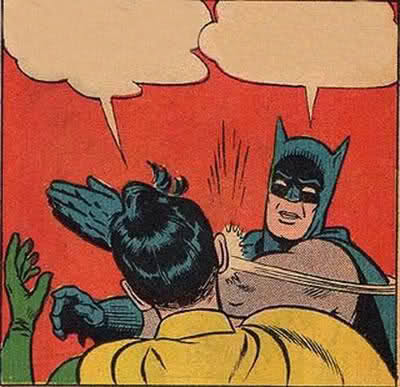
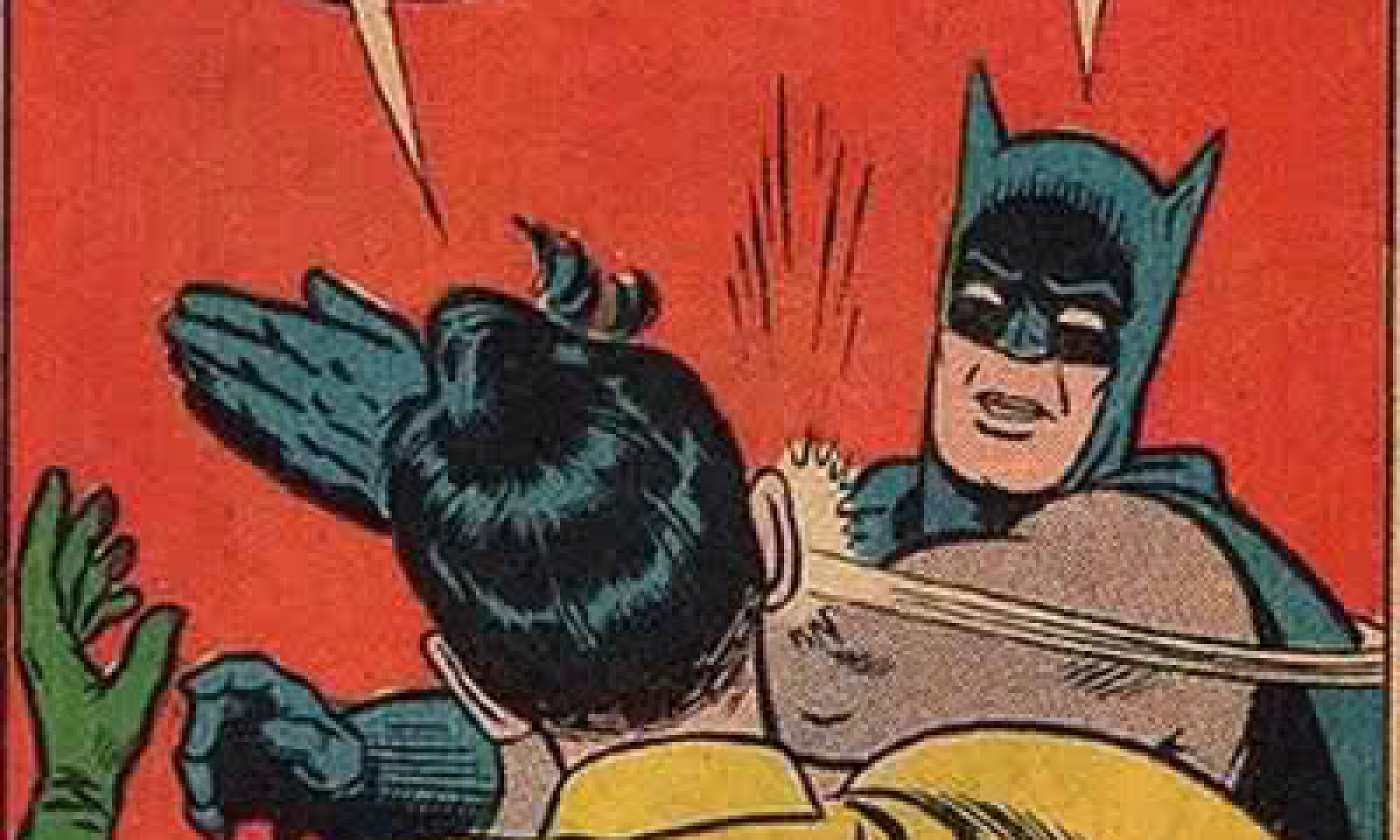
What is it about the image of Batman slapping Robin that so affects me? In its original comic book context, the orientation of the panel has Batman on the left but its life as a meme began with a reflected version that puts Batman on the right, responding to Robin rather than initiating the interaction. It depicts a grown man striking a young boy; a man who faces us but from behind a mask, striking a boy whose face we cannot see; a slap to a bare cheek delivered by a heavily gloved hand. It speaks through the cartoon speech bubbles, but what it says must be supplied anew each time it is used. The sound of slap is indicated visually by lines tracing the movement of the hand and the shockwaves it causes. The image is specular. It is simultaneously silent and deafening.

My obsession with the image began when I was already three years into my psychoanalysis but despite its late arrival, it came to be a fundamental point of reference for my analyst and me – a malleable and suggestive metaphor for a welter of psychic processes. It soon became apparent that for me the image played out an intrapsychic conflict in which I identified with both Batman and Robin. My pleasure in the represented scene was both masochistic and sadistic. I hated the precocious and eager child I had been, the child who was still within me and whom I wanted to obliterate. At the same time, I wished that I had been taught “not to make a fool of myself,” that someone had thought to give me a good slap. I wanted discipline, rigor, and control, and I wanted to discipline, rigidify, and control parts of myself that defied and threatened my adult defenses.

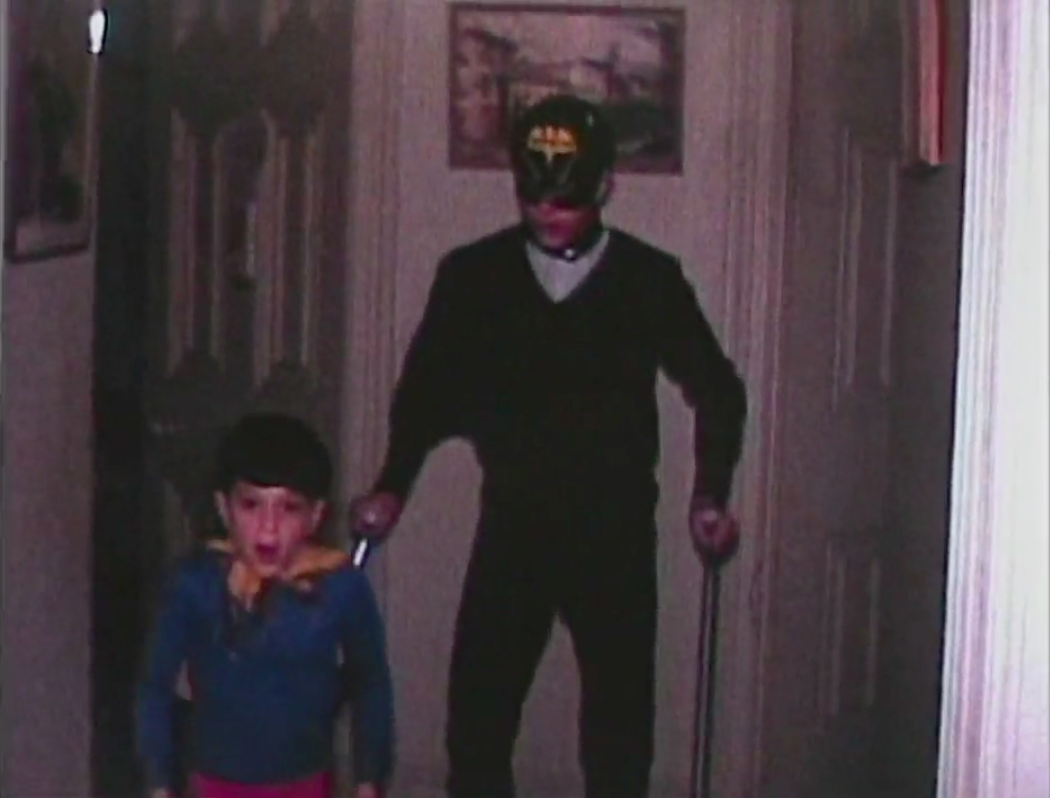
In fact, I have a history with Batman and Robin. Here I am at about six or seven years old, playing Robin in a home movie made by my then-16-year-old brother with a few of his friends.
Screen Shot 2018-10-16 at 2.30.09 PM

That Batman mask and the barely visible cape and vambraces  being worn by my brother’s friend were mine, a birthday gift because I so loved the live-action Batman TV series that was airing around that time. Yet here I am, ‘demoted’ to playing Robin! And as if that in itself were not bad enough, the ‘plot’ required me to crawl away on all fours and pee like a dog.

Screen Shot 2018-10-16 at 2.28.56 PM

And was that spot on my underwear there naturally, dirty little boy that I was? Or was it placed there by the director, my much-loved older brother, for comedic effect? Was I being betrayed humiliating myself? Was my eagerness to participate being exploited?

That live-action Batman series was also the site of premature sexual knowledge. I might have seen nothing suspicious in those shots of the Dynamic Duo climbing up a wall, Robin first, then Batman, their bodies locked together in a single crouch. But my two much older brothers and my father certainly understood their significance and so I learned it as well. It was in connection with the series that I learned, from my father, the word “catamite” and he would also refer to Robin as “Batman’s little buggery boy.”

The-Crouch

No wonder, then, that shame over my childish self, my adult desire to punish his weakness and childishness, and my childish desire to have been ‘put in my place,’ should coalesce around the image in the meme. How could I not have been gripped by it?

As work at my desk and on the couch have both progressed, in tandem, some of that ferocious self-contempt has abated. That means I find myself increasingly able to play, to be spontaneous and joyful. My book is not only tied to my analysis, though, it is part of my professional output. Philosophy as a discipline, in the Anglophone world, is dominated by rigor, clarity, precision, all the weapons of control and sadism. My book is part of an attempt to free myself from that. It approaches philosophy in a personal and ludic spirit. It is a kind of philosophical free association. The goal of inserting oneself into academic work is something is shares with (indeed, derives from) work by feminist theoreticians. But unlike the brave people who have truly put their lives on the line, it is hard for me, a person of privilege, to justify to myself and others the throwing over of the academic norms of privilege.

nietzsche

The very first time I gave a presentation on my book-in-progress in an academic setting, I remember worrying about this and, in thrashing it out in my mind, I came up with two contradictory ways of conceptualizing the presence of myself in my work. Rather than choose between them, I read the two opposing introductory paragraphs (along with a further two) at the talk. Here is one:

Many people have a strong desire to speak, or more pertinently, to write about themselves… What I am talking about is a strong, almost primordial desire, stemming from our earliest years, for visibility – a desire to be seen and known. To be counted. But a desire to be seen depends on others to see us. One must fight for the attention of, and recognition by, others who may have no interest in seeing or counting one. For those, then, who seek to gratify this desire to be seen through self-writing, various strategies present themselves. Humor is one obvious way to mediate one’s desire for recognition – the child learns not to scream, but to caper! Lyricism is another. More complex strategies are also available. The general can be coaxed from the particular details of a life so that in reading about the other, the reader can also read about herself. And, where the events and idiosyncracies of a person’s life are of a kind that are theorized about in some on-going discursive practice, some variety of theory, the possibility arises of intertwining the expression of the desire for visibility with the pursuit of that discursive practice.

Whatever form the accommodation takes, it is a compromise between the childish desire to be seen and the adult realization that being seen requires an other to do the seeing and that such seeing is not simply there for the taking. The childish desire to show one’s face is met, as it were, with a slap by the reality principle that knows that to be seen, a face must mask itself in some way to make it enticing to the viewer. The upwelling or over-flowing needs of the id must be tamped down by the ego and super-ego.

canvas

That is what I see in this image. An enthusiastic, youthful Robin, as yet unsuccessful in making himself visible to us, is schooled by the older Batman. “No-one is interested in you, Robin,” the image itself seems to say. “Your childish capers are insufficient excuse to speak. Wear a mask!”

My book is a project conducted under the dubious sign of this equivocal image. But the mask I shall wear, the theoretical discourse by means of which events and idiosyncracies of my life will gain expression, will be the dry and dusty discourse of analytic philosophy. You may imagine, if you choose, what expressions and what distortions of my self this will allow and entail.

In this introduction, I am the little boy, desperate for attention, sneaking my person into philosophy that, for others, helps the medicine go down. This little boy needs to be stopped from making a fool of himself, needs to be taught his insignificance. Here is the other introduction:

In 1969, the expression “the personal is political” was coined by feminist thinkers to challenge the idea that there is a disjuncture between the personal and the broader structures of power in which individuals are inscribed. If we interpret “political” broadly, so as to include all forms of public, institutional discourse, a special case of the expression would be “the personal is philosophical.” This special case would cover efforts to overcome the disjuncture between the personal and the conventions and norms of philosophy as a discipline. Those norms enjoin authors to keep their own personalities out of their work, enjoin readers to focus only on the ‘ideas’ in the text, ideas that are supposed to be able to circulate without any vital connection to the lives and circumstances of their authors. This valorization of objectivity and impersonality, with its effacement of the people who produce philosophy and the ways their individuality affects the contents of their philosophy, has left philosophy shriveled and immature, deprived of the nourishing life-blood of the real people who make it. What is desperately needed for the reinvigoration of philosophy is the rude and forceful interpellation of our stunted disciplinary norms by the subject, in all her strange specificity and individuality. Auto-theory is one form this interpellation can take: the calling out of a moribund modality of philosophy by the subject, slowly and seductively revealing her own face. But because each subject is singular, unique, and real, the face of her desire, even as it reveals itself, will always retain an element of inscrutability to the other. “Fetish” is the name we give to what is inexplicable, what is surd, in desire.

canvas

My project is a work of auto-theory, conducted under the sign of this image in which the joyful, liberating, fetish-clad warrior, in his idiosyncratic singularity, forces the intrusion of the personal onto the stunted, childish discipline of academic philosophy, trying, with a slap, to bring the blood to its face, trying to rouse it from its valorization, at once perverse and torpid, of the production of philosophy without a visible human face.

For me, the image of Batman slapping Robin is about the relation of adult to child, of work to play, of the settled ways of doing things and the playful impetus to experiment, of id and superego. Working with it, and on it, has been integral both to my analysis and to my philosophical development. It has allowed me to make peace with my childish self. I hope that, at some point in the not too distant future, it will help me erase the distinction altogether between adult and child.
Batman AI

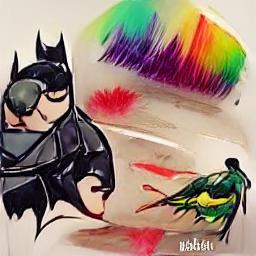
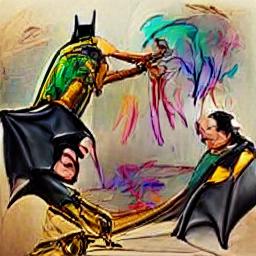
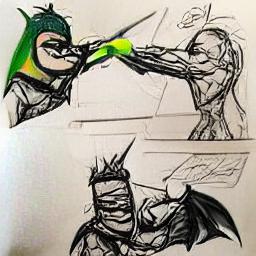
I’ve been playing around with one of these AI image generators using the instruction “Batman slapping Robin in the style of…” and altering some of the other parameters pretty much at random. Some of the results are really striking so I thought I would share them with you.


Just “Batman slapping Robin”
Here in the style of Dali
Caravaggio
A Leonardo cartoon
A Mapplethorpe portrait
… and Rothko

I’ve generally liked the AI-generated images people have been creating and I must say, I find these ones really evocative.

Is there balm in Gilead?

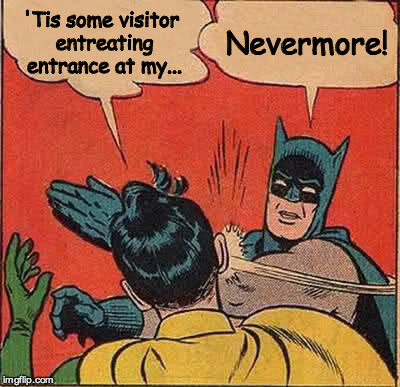
One theme that suffuses my book-in-progress, A Certain Gesture: Evnine’s Batman Meme Project and Its Parerga!, a theme I have not written much about on this blog, is exile. I was moved to write something about it today when, by a series of fortuitous connections, it ran up against one of the memes from my book.

raven

(The book’s commentary on the meme, however, deals with quite different issues.)  I was reading a review, by Nathan Goldman, of Joshua Cohen’s recent novel The Netanyahus. The novel is a fictionalized account of the coming to America of the Israeli historian Ben-Zion Netanyahu, along with his family, including his son Benjamin, future prime minister of Israel.

In the novel, the elder Netanyahu is asked to teach a class on the Bible as part of the hiring process. In the course of this class, he says:

Zion, because it was remembered not as written history but as interpretable story, was able to exist again in actuality, with the founding of the modern state of Israel. With the establishment of Israel, the poetic was returned to the practical . . . Now that Israel exists, however, the days of the Bible tales are finished and the true history of my people can finally begin.

In life, Ben-Zion Netanyahu had worked as an assistant for the Zionist Revisionist leader Ze’ev Jabotinsky and Goldman, the reviewer, quotes Jabotinsky as having said, during a speech in 1938:

Eliminate the Diaspora or the Diaspora will eliminate you.

1938. It would have been then, or perhaps a year or two earlier, that my father heard Jabotinsky speak in London. (Jabotinsky lived in London from 1936 until his death in 1940.) That encounter left an indelible mark on my father who from then on remained a faithful adherent of Jabotinsky’s brand of Zionism. Perhaps he heard that very sentence from Jabotinsky’s own mouth. It certainly expresses a sentiment my father fervently shared. It was this sentiment that I had to work so hard to free myself from, separating myself from the tents of my father and striking forth into the wilderness, into a kind of exile. (This was happening right around the time my parents picked up and moved, finally, to Israel, leaving me, aged 18, effectively an orphan in London.)

I particularly like Cohen’s imagining of Netanyahu’s words because it so readily offers me the language for my own view. For Netanyahu, the “days of Bibles tales” extend all the way up to the founding of the state of Israel. It is only with this event that the history of the Jews begins. My own, more melancholy, take on the founding of Israel is that it marks the end of the history, if not of the Jews, at least of Judaism. It is the point at which a large segment of Jewry turned its back on the particular ‘genius’ of Judaism and plunged bloodily and enthusiastically into being a nation like any other.

The ‘genius’ of Judaism, of course, is exile. The Bible (and here I agree with Netanyahu) does not detail the early history of the Jews. It is a pre-historic myth, an origin story, needed to establish the basis for the real beginning of Jewish history – the exile of 70CE. It is not the Bible that is the book of which Jews are the people, it is the Talmud. The Talmud itself, by a clever trick, manages even to be in exile from itself. It exists in two versions, the Jerusalem (or Palestinian) Talmud and the Babylonian Talmud. The latter, naturally, eclipses the former in prominence. Since that time, the Jews have embodied unrootedness. Unrootedness is something that anti-Semites have used to foster hatred and suspicion of them. I think a similar accusation lies barely concealed beneath the surface of Ben-Zion Netanyahu’s words – words not at all uncommon in Zionist circles.

Life in exile is a terrible burden and a precious gift. Though it has brought me suffering I would not give it up for the world. (I hope my book will express something of how exile has characterized my life.) I spoke in an earlier post of being, as a Jew, for the letter. I can’t yet explain precisely how but this seems, in my own mind, to be the same as being for exile.

In the book’s commentary on the meme above, I discuss many things, among which is the influence of Poe on the Portuguese poet Fernando Pessoa. (You will get an inkling of why if I tell you my main source is a paper by the Pessoa scholar George Monteiro entitled “The Bat and the Raven.”) Pessoa translated Poe’s poem into Portuguese. One of the elements of Jabotinsky’s hagiography that I grew up with was his having translated “The Raven” into Hebrew. In fact, he translated it into both Hebrew and Russian. (He was a gifted linguist.) You can see the MS, in which he used Latin characters (I don’t know why) here. It was in my pre-exilic years, in the bosom of my family, that I first learned “The Raven” from my father.

That is not it, at all: clarity and sadism

That is not what I meant at all;
               That is not it, at all.
T.S. Eliot
 
Throughout my philosophical career, one virtue my writing has been consistently praised for is its clarity. Just about every journal referee and every book reviewer has used that very word or one of its cognates. Not its profundity, not its wisdom, not how interesting it is. It’s always clarity, clarity, clarity. And I’m OK with that. I value clarity very highly. Moreover, my discipline, analytic philosophy, is founded on and built around the quest for clarity so my personal virtue is syntonic with the standards of my profession.
 
But things have been shifting for me lately and, without revoking my approval of clarity, I have come to see it also in other ways. Part of writing clearly is anticipating, and forestalling, potential ambiguities, misunderstandings, and irrelevant but tempting byways. Clear writing, in other words, serves to direct the reader’s thought along exactly the path the author wishes. I would put it in even stronger terms. Clear writing is designed to occupy the reader’s mind, to colonize it, forcing it to renounce its freedom and follow slavishly the writer’s direction of thought.
 
Deploying a psychoanalytic concept developed by Melanie Klein and her followers, clarity in writing seems to me to be a mechanism of projective identification. Here is part of the definition of projective identification from the New Dictionary of Kleinian Thought (2011):
 

Projective identification is an unconscious phantasy in which aspects of the self or an internal object are split off and attributed to an external object.

The projected aspects may be felt by the projector to be either good or bad. Projective phantasies may or may not be accompanied by evocative behaviour unconsciously intended to induce the recipient of the projection to feel and act in accordance with the projective phantasy.

In analysis, the patient projects parts of their mind into the analyst and then, subtly and unconsciously, strives to get the analyst to act in conformity with it. If the patient, for example, has aggressive and sadistic phantasies they cannot assimilate, they will attempt to elicit aggressive and sadistic behavior from the analyst. It is both a dangerous and valuable game.

Clear writing, too, is aggressive and sadistic – not in its content but in the domination it attempts. The reader is ‘forced’ to look here and not there (where their own phantasies might take them), to disregard this but to give that a lot of weight, to understand something polysemous in one way and not another. I imagine that what is being projected through this mechanism is the writer’s own anxiety, anxiety about confusion, about uncertainty, about getting lost, about being swallowed up by a messy, stinking pile of conceptual detritus. Writing clearly makes the writer work hard to control what they produce and at the same time, disallows anyone else the freedom to just let it all go.

I, certainly, whose care and intellectual hygiene so routinely earns me praise from my readers, am beset by these anxieties.†

My book-in-progress, A Certain Gesture: Evnine’s Batman Meme Project and Its Parerga!, exhibits my internal struggles around these issues. I have sometimes said that a key way of understanding its organization is through the analytic concept of free association. Free association is a mode of talking which deliberately tries to set clarity aside. As in free association, so in my book, one thing leads to another not through linear logic but through chance associations, phantasy, and play. The book as a whole does not ‘add up to anything.’ Not making any point, it cannot have a telic structure. It can be read in any order. The emphasis placed on the parergon means that the work is not even sharply divided from what lies outside it. ‘The work’ barely exists at all. What could be messier than a work that cannot be distinguished from its frame? Or even from its didactic?

Concurrently with work on my book, anxieties about free association in analysis have been gradually soothed so that now, after 8 years, I finally find myself occasionally able to talk freely. It’s a great feeling.‡ I look forward, too, to writing philosophy that is no longer ‘clear’ but manages to be interesting or profound instead.

† I have written here about my horror of things like nonsensical words in children’s songs .

‡ Anton Kris, in his book Free Association: Methods and Process, emphasizes the effect of free associating on the patient’s well-being.

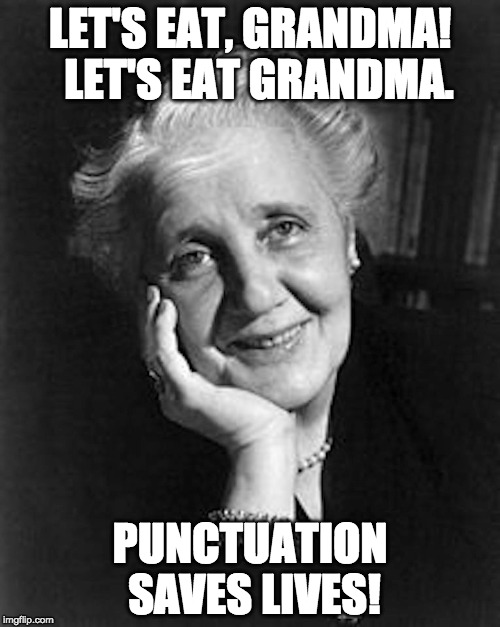
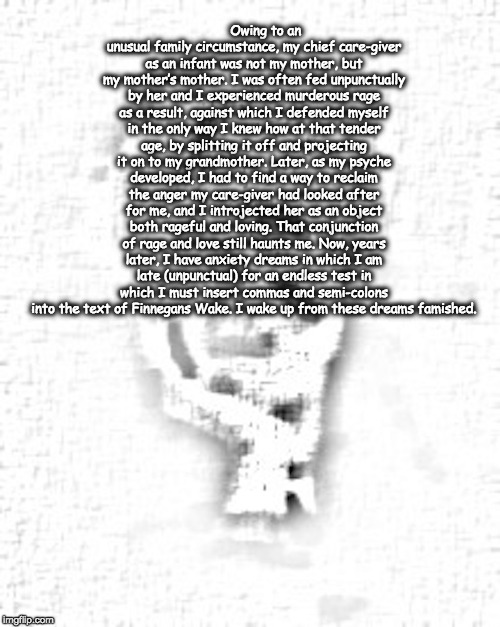
An Increasingly Verbose meme. A grandmotherly Melanie Klein becomes sketchier as the jokey example used to illustrate the importance of proper punctuation becomes more verbose and, in the final panel, more Kleinian.

Image, writing and speech – in Italian

I’m excited to share with you an edited version of a talk I gave in Genoa a couple of years ago, now in virtual printed form. The piece is about one of the themes that runs through my book-in-progress A Certain Gesture: Evnine’s Batman Meme Project and Its Parerga! – the relations between speech represented in writing that appears as part of an image. Many of the memes exploit the possibilities raised by these interrelations.